Image 1 Caption:
The animation illustrates a
(probably) chaotic
gravitationally-bound
three-body system.
We see the approximate
orbital trajectories
of three identical
point masses
initially at rest
in the
inertial frame
defined by their mutual
center of mass.
The point masses
are, of course,
located at the vertices
a triangle which at almost all times
is a
scalene triangle.
The center of mass stays at rest
in obedience to the
law of
conservation of momentum.
Now, if
a (gravitationally-bound)
multi-body system has
3 or more members,
then its orbit motions
will usually be chaotic
and, if so, then
individual members can by
gravitational assists
(i.e., gravitational interactions in which
kinetic energy is acquired)
acquire
enough kinetic energy to achieve
escape velocity
and go to infinity.
This escape process is called
gravitational evaporation
where the term "evaporation" is being used in a special
astro-jargon sense
and NOT in the ordinary sense of
evaporation.
Note,
gravitational evaporation
is NOT Hawking radiation.
A multi-body system
undergoing
gravitational evaporation
becomes more tightly
gravitationally bound
every time an
astro-body escapes to
infinity.
This means the
gravitational evaporation
slows down with every escape to infinity since
it becomes more unlikely for a chaotic
gravitational assist
to provide enough kinetic energy
for an escape.
N-Body Problem Simulation, 48 Masses, Random Start | Gravity | Physics Simulations | 1:30:
The video shows
n-body simulation
(i.e., computer simulation
of multi-body system)
consisting of 48
point masses
(which means they have NO size and CANNOT hit each other in a body-on-body sense,
but only interact via gravity).
For illustrative reasons, the point masses
are made to look finite.
The motions are chaotic and some
point masses apparently
escape to infinity though that is NOT
given by the caption.
Some point masses leave
the viewing screen during the video.
Note, center of mass does NOT
relative to the multi-body system
since it constitutes an isolated
center-of-mass inertial frame.
Note, motions are only in the screen
plane since the
momentum in
perpendicular to the
screen
plane is set to
zero and it CANNOT change from
zero due to
conservation of momentum.
Exact conservation of momentum
perpendicular to the screen would
be impossible to arrange in any 3-dimensional
n-body simulation, but
a 2-dimensional
n-body simulation
(such as in the video) it is just built in.
Short enough for the classroom.
The
evaporation of open clusters of stars
N-Body Problem Simulation, 48 Masses, Random Start | Gravity | Physics Simulations | 1:30
Features:
The three-body system
in the animation
is probably NOT in a periodic solution
(of the three-body problem),
but the original caption of the
animation made NO definite
statement.
The solution, in fact, is probably
chaotic.
The solution was probably calculated
by an N-body simulation.
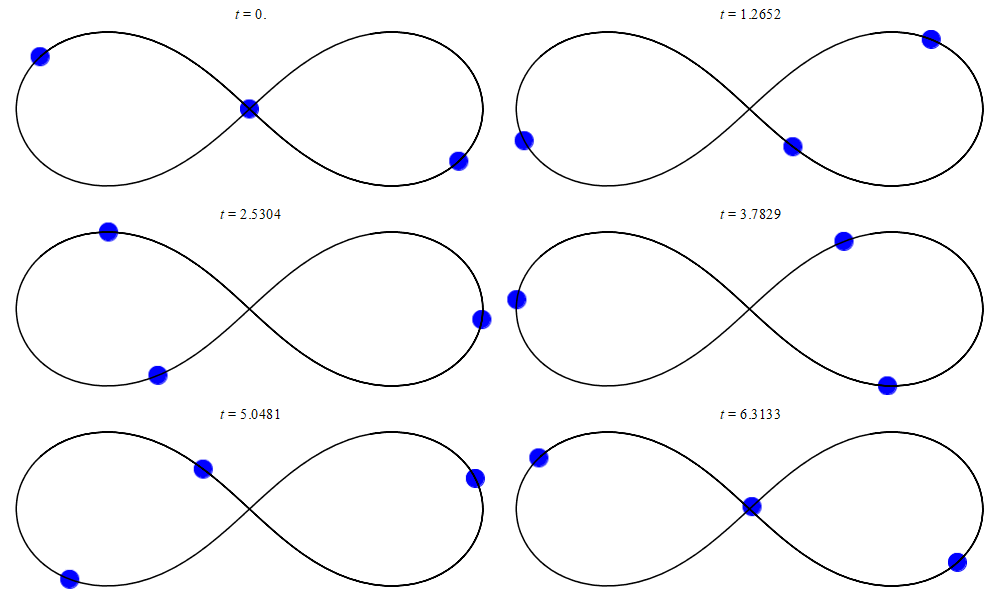
Image 2 Caption:
An animation
of the
figure-8 orbit solution
for a
gravitationally bound
three-body system
over a single
orbital period
of T = 6.3259 in some time
unit
(see Wikipedia:
Three-body problem: Special-case solutions).
The solution in this case is periodic.
Thus, it is an exact periodic solution of the
three-body system.
However, there is NO
closed-form formula
(i.e., NO
formula one can just write down).
The
figure-8 orbit solution
is (neutrally) stable to small
astronomical perturbations, but
its range of (neutral) stability is very small.
So it probably occurs only rarely and fleetingly in
nature and has NEVER been observed.
Note stability
for orbits
is usually neutral stability
in yours truly's understanding.
So astronomical perturbations
cause changes that are NOT damped out as for
stable equilibriums,
but the changes do NOT grow without bound as for
unstable equilibriums.
The changes in a vague sense are roughly proportional to the
astronomical perturbations.
However, stable equilibriums
and unstable equilibriums
do occur for orbits.
For example, consider the Lagrange point
orbits.
The L4 and L5 points
are stable equilibriums
for orbits
and the
L1,
L2,
and L3 points
are unstable equilibriums
orbits.
For more on the Lagrange points,
see Orbit file:
lagrange_points.html
See also the definition
of figure eight (AKA figure 8).

