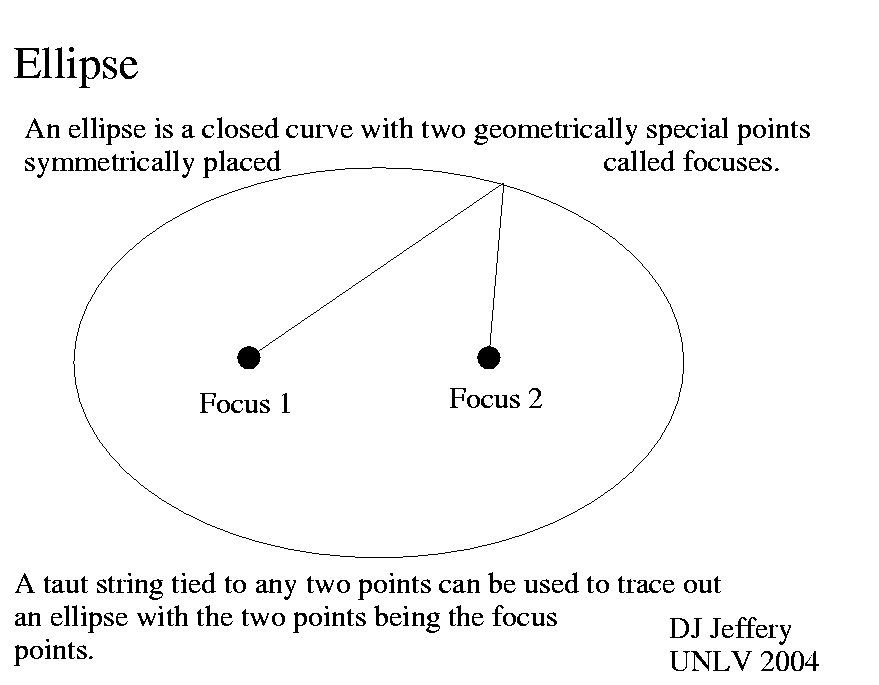
Figure: An explication of why Apollonius, the ancient expert of ellipses, did not use them in astronomy
Image 1 Caption: A general ellipse. For explication of the image, see File: Mathematics file: ellipse.html
Further explication
-
One of the great ironies
of the
history of astronomy
is that ancient authority on ellipses
Apollonius of Perga (c.262--c.190 BCE)
is believed to have invented
epicycle models
for planetary orbits instead of
using ellipses which are the true
shape of planetary orbits to
2nd order approximation.
To 1st order approximation,
the orbits are circles.
For epicycle models,
see Wikipedia: Deferent and epicycle: History.
Hereafter, we will assume Apollonius as a simplification.
Note Apollonius did NOT use formulae in a modern sense. He worked purely in words and diagrams. His understanding of ellipses was based on his study of conic sections which are illustrated in Image 2 and described in the next list item.

- Image 2 Caption: "The conic sections (circle, ellipse, parabola, and hyperbola) are 2-dimensional figures formed by the intersection of a plane with a cone at different angles. The theory of these figures was developed extensively by the ancient Greek mathematicians, surviving especially in works such as those of Apollonius of Perga (c.262--c.190 BCE). The conic sections pervade modern mathematics." (Slightly edited.)
- Apollonius' "goof" in NOT using ellipses for planetary orbits is explained by noting that the planetary data in his day did NOT compel elliptical orbits and epicycle models seemed adequate and were simpler to understand.
Something always to remember about ancient Greek astronomers: they could NOT measure distances to astro-bodies, except that eventually they got a fairly good distance to the Moon of ∼ 60 Earth equatorial radii (with R_eq_⊕ = 6378.1370 km). This meant that they could NOT know directly where anything was in 3-dimensional outer space, except for the Moon. For more information on their distance problem, see Ancient Astronomy file: distance_problem.html.
- Note in particular, ancient Greek astronomers had difficulty dealing with non-uniform motions mathematically which planets have on their orbits no matter how you think of them. The ancient Greek astronomers did NOT have calculus which is needed for the mathematical description of non-uniform motions in general.
The approach they took to deal with non-uniform motions in Heavens was decompose them into uniform circular motions that compounded reproduced to some accuracy/precision the motions of the planets.
In Aristotelian cosmology, the uniform circular motions were of compounded celestial spheres that carried the planets around.
In Ptolemaic system, the uniform circular motions were those on the deferent and epicycle of epicycle models.
- Compounded uniform circular motions are illustrated in the Image 3 below.
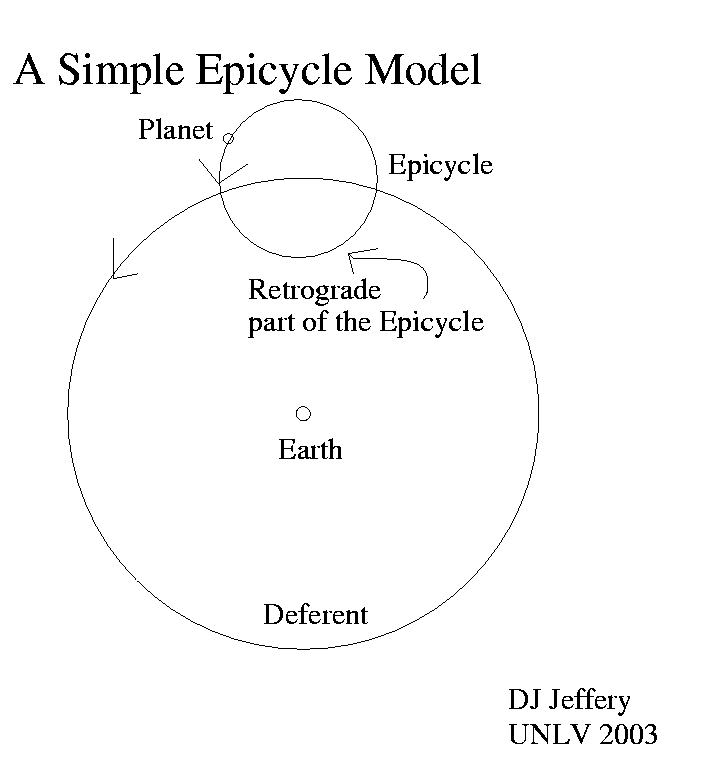
- Image 3 Caption: An illustration of a simple epicycle model. For a full explication of Image 3, see File: Ptolemy file: epicycle.html.
- Before 1600, astronomers working in the western Eurasian tradition of astronomy continued to rely on compounded uniform circular motions in their Solar System models.
- The hold of compounded uniform circular motions was only broken by Johannes Kepler (1571--1630) who was one of the leading mathematical innovators of the Scientific Revolution of the 16th and 17th centuries and also a person who was willing to do long tedious calculations to deal with non-uniform motions.
- In modern times, epicycles have been used as mathematical tool in analyzing the orbits of astro-bodies in galaxies (see Wikipedia: Lindblad resonance). However, these modern epicycles have been criticized too and maybe are on their way out of modern use (Francis, C. 2011, arXiv:0911.1594v1, "Lindblad's epicycles - valid method or bad science?").
- Image 2 Caption: "The conic sections (circle, ellipse, parabola, and hyperbola) are 2-dimensional figures formed by the intersection of a plane with a cone at different angles. The theory of these figures was developed extensively by the ancient Greek mathematicians, surviving especially in works such as those of Apollonius of Perga (c.262--c.190 BCE). The conic sections pervade modern mathematics." (Slightly edited.)

Credit and/or file tracking information follows to the divider line:
-
Images:
- Credit/Permission: ©
David Jeffery,
2004 / Own work.
Image link: Itself.
- Credit/Permission: ©
User:Magister Mathematicae,
2012
(uploaded to
Wikimedia Commons
by User:Magog the Ogre,
2021) /
CC BY-SA 3.0.
Image link: Wikimedia Commons: File:Conic Sections.svg.
- Credit/Permission: ©
David Jeffery,
2003 / Own work.
Image link: Itself.
-
Local file: local link: ellipse_apollonius.html.
File: Ptolemy file: ellipse_apollonius.html.