
Figure: A labeled near side Moon map, a NASA video on Moon geography, and Moon facts
Image 1 Caption: An image moon map of the near side of the Moon with the major maria (singular mare, vocalized mar-ray) and lunar craters identified.
See also the NASA video NASA: LRO PDS Release Released Tuesday, March 15, 2011 ID:10146 | 1:18: Authoritative: When composited into a global mosaic, the images from the Lunar Reconnaissance Orbiter's (2009--) wide angle camera (WAC) can show the mineral content and morphology of the lunar surface Good for a minut or so for the classroom.
List: Earth-Moon-System Facts:
Note, this long list is just to show that fact numbers actually are known and you can contemplate them at your leisure. We will just look at the few numbers recapitulated below in Image 2.
- Earth symbol ⊕ = E
- Moon ☽ = Mo
- gravitational constant G = 6.67408(31)*10**(-11) (MKS units)
- Earth mass M_⊕ = 5.9722*10**24 kg = 81.3005677 M_moon
- Earth equatorial radius R_eq_⊕ = 6378.1370 km
- Earth mean radius R_me_⊕ = 6371.0088 km
- Earth polar radius R_po_⊕= 6356.7523 km
- Moon mass M_Mo = 7.342*10**22 kg = 0.0123000371 M_⊕ = 1/81.3005678 M_⊕ ≅ 1/80 M_⊕
- Moon radius:
R_eq_Mo = 1738.14 km = 0.2725 R_eq_⊕ R_me_Mo = 1737.10 km = 0.2727 R_eq_⊕
R_po_Mo = 1736.0 km = 0.2731 R_eq_⊕
- mean angular diameter = 0.5174° = 31.04' which is almost the same as the Sun's mean angular diameter = 0.5329° = 31.97' (Cox-16,303,305?).
- axial tilt to the
ecliptic pole = 1.5424°
which is much less than the
Earth's axial tilt = 23.439281°
(J2000?).
- Moon mean orbital radius R_Mo = 384,748 km = 60.3229 R_eq_⊕ ≅ 60 R_eq_⊕
- Moon orbital eccentricity = 0.0549006 (mean) ≅ 5.5 %
- Moon orbital inclination = 5.145° (mean)
- lunar month = 29.530588861 days (J2000) ≅ 29.53059 days (mean J2000 to 7 digits) ≅ 29.5 days: The new moon to new moon period.
- mean lunar sidereal month 27.321661547 days (J2000) ≅ 27.32166 days (to 7 digits) ≅ 27.3 days: The physical orbital period relative to the observable universe.
- lunar anomalistic month
= 27.554550 days (mean J2000 to 7 digits) ≅ 27.6 days:
The perigee to
perigee period.
It differs from the
mean lunar sidereal month
because of
astronomical perturbations.
Keywords: apogee, apsis (apogee, perigee), barycenter, celestial mechanics, center of mass, Earth, eccentricity, fixed stars, inertial frame, J2000, mass, mean orbital radius (AKA semi-major axis), Moon, orbit, (circular orbits, elliptical orbit), orbital inclination, orbital period, planet symbols, perigee, radius, semi-major axis, etc.
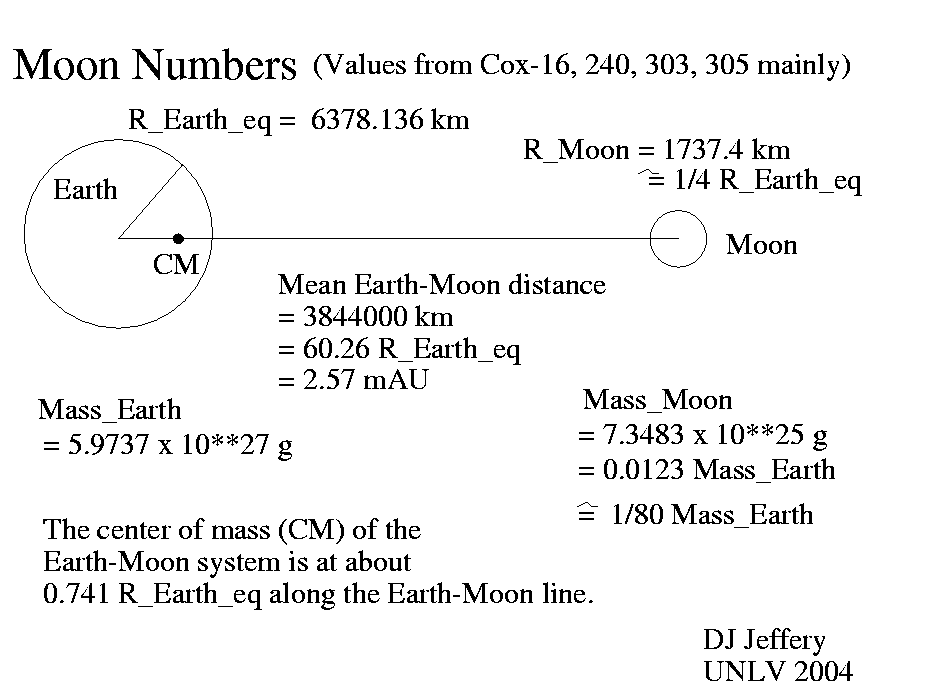
Image 2 Caption: Earth and Moon numbers relevant to astronomy (Cox-16,240,303,305).
See also Moon keywords below (local link / general link: moon_keywords.html):
Credit and/or file tracking information follows to the divider line:
EOF
Images:
Local file: local link: moon_facts.
Image link: Wikipedia:
File:Moon names.svg.
Image link: Itself.
File: Moon file:
moon_facts.html.
