
Figure: Illustrations and explication of hohlraums
Image 1 Caption: The image is hohlraum (radiation cavity) with small hole to the interior cavity. The interior wall diffusely reflects and eventually ideally fully absorbs any incoming light ray because the wall has some absorption opacity. The hole appears ideally as a non-reflecting surface (i.e., blackbody radiator surface). The hohlraum wall is held at fixed temperature, and thus the interior radiation field is ideally exact blackbody radiation at the same temperature as the wall and it is continually being emitted and absorbed by the wall. The hole must also radiate blackbody radiation, and thus is ideally an exact blackbody radiator relative to the outside environment no matter what the outside environment's overall radiation field is.
Further explication:
- The
hohlraum (AKA radiation cavity)
is an experimentally important device for creating
ideally an exact
blackbody radiation field in its interior and being ideally an exact
blackbody radiator
at its small hole to the outside environment.
Real hohlraums can be made very very close to the ideal ones.
- A hohlraum is just
a opaque container with a cavity with approximately zero opacity which
is what air has for small enough containers.
If the container has a uniform temperature, its wall will continually radiate
a radiation field that
must be in thermodynamic equilibrium with the wall.
The wall also continually absorbs this radiation field to maintain the
thermodynamic equilibrium.
The wall can also reflect some of the blackbody radiation. However, all processes cancel out ideally and there is what is called a detailed balance of processes.
A thermodynamic equilibrium radiation field is called blackbody radiation for historical reasons we explain below.
Blackbody radiation can be very bright, and so the name is not very good, but we are stuck with it for the aforesaid historical reasons.
- Note, it is a fundamental
thermodynamics
property of matter above zero temperature on the
Kelvin scale to emit
electromagnetic radiation (EMR)
This is emission is called
thermal radiation
and it is in general not blackbody radiation, but is in the hohlraum case.
However, blackbody radiation is often used as a synonym for any thermal radiation that has a continuous spectrum (i.e., a fairly smooth spectrum) with the understanding that it is not exact blackbody radiation in general. In general, thermal radiation will be mixture of blackbody radiations of different temperatures and/or a diluted blackbody radiation. Diluted blackbody radiation has the blackbody spectrum shape, but its energy density is lower than (exact) blackbody radiation.
- Hohlraums were experimentally
important at least in the
19th century
because it is how
blackbody radiation was experimentally investigated.
The hohlraums had a small hole (as shown in Image 1) to allow a small escape of their internal blackbody radiation whose spectrum could be analyzed. In modern times, you would not need a hole. You would embed an electronic detector in hohlraum.
Since the hole ideally absorbs all light that enters for reasons given above, it is ideally completely non-reflecting and so is ideally black in that sense.
Real holes that are sufficiently small are negligible perturbations of holhraum internal blackbody radiation field.
- A body that is ideally non-reflecting at its surface
and in an optically thick near-surface interior
which is at a uniform temperature will emit at its surface
blackbody radiation and this is kind of body is called a
blackbody radiator.
A blackbody radiator
is black in the sense that it is non-reflecting and hence the names
blackbody radiator and blackbody radiation.
But a blackbody radiator can be very bright, and as aforementioned
the name is historical and we are stuck with it.
Nearly exact blackbody radiation itself is common as discussed in Blackbody file: blackbody_spectra.html where optically thick and optically thin conditions are also discussed.
But exact blackbody radiators emitting into a transparent environment where the overall radiation field is not blackbody radiation and has much lower energy density than the blackbody radiation from of the blackbody radiators are very rare in nature.
They are rare because you require a thermodynamic equilibrium radiation field emission into an environment that is more or less far from being thermodynamic equilibrium with the radiating body.
The hole of hohlraum is very close to an ideal blackbody radiator, but the hole is not an optically thick surface layer and so is not what is usually meant by the term blackbody radiator.
Crevasses into unlit rooms with walls at nearly uniform temperature are somewhat less-than-ideal blackbody radiators and are common, but again crevasses are not optically thick surface layers. So, in fact, fairly good blackbody radiators are common in everyday life.
- What you generally observe from bodies with optically thick surfaces layers
that have a uniform temperature is a diluted
modulated black body radiation.
To explicate, first assume the surface layers are partially reflective but the reflection is wavelength independent. In this case, some of the blackbody radiation field generated by the uniform temperature matter is reflected back into the interior of the body and the radiation emitted at the surface has a spectrum with blackbody radiation shape, but less than blackbody radiation energy density. This kind of emitted radiation is called diluted blackbody radiation. The name diluted blackbody radiation may not be very common, but is used in astrophysical radiative transfer (e.g., Mi-120). Radiative transfer is propagation of EMR through media.
Now nearly ideal wavelength-independent reflectivity is rare, and so in general the emission from optically thick surface layers at uniform temperature will have dilusted blackbody spectrum modulated by the wavelength dependence, and so it will not have exactly a blackbody spectrum shape in general. However, over certain wavelength bands the modulation may be small.
In fact, in the terrestrial environment the modulation in the visible band (fiducial range 0.4--0.7 μm = 400--700 nm = 4000--7000 Å) is small for many hot EMR radiators with opticially thick surface layers.
The modulation and dilution effect can be accounted for a factor called the emissivity (symbol ε) which is multiplied by B_λ(T) the blackbody radiation specific intensity which is discussed Blackbody file: blackbody_spectra.html.
- Blackbody radiation is very important in astrophysics for many reasons.
See Blackbody file:
blackbody_spectra.html.
However, one of the key reasons is that main-sequence stars (theoretically understood to be those stars nuclearly burning hydrogen (H) to helium (He) in their cores) approximate blackbody radiatiors. To be more exact, stellar photospheres (i.e., the layers from which photons can escape to infinity) approximate blackbody radiators. (See, e.g., Hu-21--22 for more on stellar photospheres.)
That this is so allows us to estimate the effective temperature (a sort of average photospheric temperature) using Wien's law For more on this subject, see Blackbody file: blackbody_spectra.html and File: Blackbody file: wien_law.html.
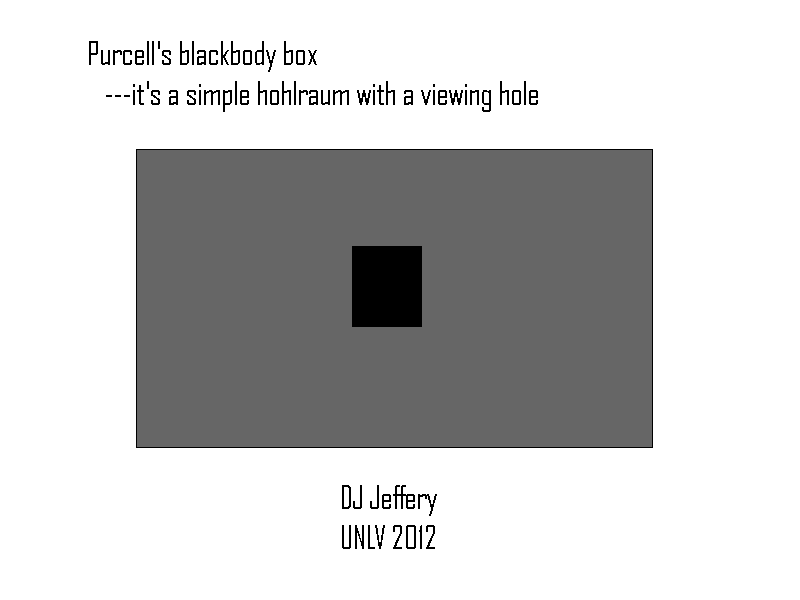
- Image 2 Caption: An educationally useful and fun toy hohlraum is the Purcell's hohlraum.
- The Purcell's hohlraum is just a close black box with one small hole.
Like any hohlraum, negligible light is reflected out of the hole, and so it is noticeably blacker than the black box itself unless the box is made of some super black material like vantablack (99.965 % absorbing).
Also like any hohlraum, the hole in Purcell's hohlraum is nearly an exact blackbody radiator, but its blackbody radiation emission is just at the ambient air temperature at least approximately.
- In fact, the emitted blackbody radiation is pretty much the same as what is everywhere in the room which is rather less-than-ideal hohlraum itself.
- For ordinary room temperatures (i.e., about 300 K ≅ 27° C = 80.6° F), the blackbody radiation for a Purcell's hohlraum and the room peaks at about 10 microns which is the well into the infrared band (fiducial range 0.7 μm -- 0.1 cm) and so we do not see it. This is why the hole looks very black.
- You too can make your own Purcell's hohlraum from any completely closed carton of some kind.
Seal the carton thoroughly, put a black sheet of paper on one side and punch a small hole in the paper and carton.
As aforesaid, the blackbody spectrum is invisible to the human eye, and so all you see is blackness---blacker than the black paper:
- Image 2 Caption: An educationally useful and fun toy hohlraum is the Purcell's hohlraum.
Credit and/or file tracking information follows to the divider line:
Images:- Credit/Permission:
Χρήστης:Παν
2006
(User:User:File Upload Bot (Magnus Manske),
2010) /
Public domain.
Image link: Wikimedia Commons: File:Cavity radiation.jpg.
- Credit/Permission: ©
David Jeffery,
2012 / Own work.
Image link: Itself.

File: Blackbody file: hohlraum.html.