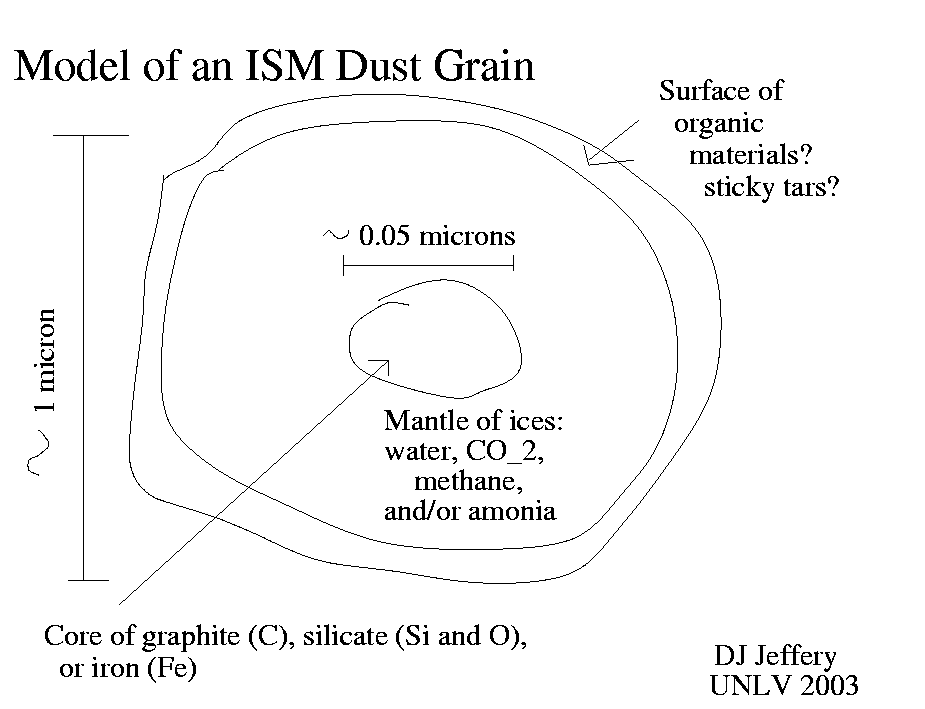
Figure: Interstellar dust cartoons and brief explication of interstellar dust
Image 1 Caption: A cartoon of a model of an interstellar dust grain: sizes down to ∼ 0.0003 microns can occur (Ze-337; HI-371,374). Note, ammonia (NH_3) is spelt wrong in Image 1. Ammonia at room temperatures is a colorless, pungent gas that dissolves easily in water.
Further explication:
- The ices
would probably only be present in dense
nebulae like
molecular clouds
and protoplanetary disks???
where it it cold enough for them and they are largely shielded from
electromagnetic radiation (EMR)
in the
ultraviolet band (fiducial range 0.01--0.4 μm)???.
- Image 2 Caption:
Image 2
A more detailed model of an
interstellar dust grain
with a silicate core and a mantle
of ices:
- atomic hydrogen (H) (which is probably just isolated atoms since atomic hydrogen does not form an ice.
- ammonia (NH3).
- carbon dioxide (CO2) (called dry ice when solid).
- carbon monoxide (CO).
- formaldehyde (H2CO or CH2O).
- methane (CH4).
- methanol (CH3OH).
- molecular hydrogen (H2).
- water (H2O).
- organic molecules which are all molecules containing carbon (C).

Credit and/or file tracking information follows to the divider line:
Images:- Credit/Permission: ©
Ralf Srama et al., 2009 / No permission.
Image link: Itself.
Image website: Ralf Srama et al., 2009.
Placeholder image: alien_click_to_see_image.html. - Credit/Permission: ©
David Jeffery,
2003 / Own work.
Image link: Itself.
File: Star file: interstellar_dust.html.