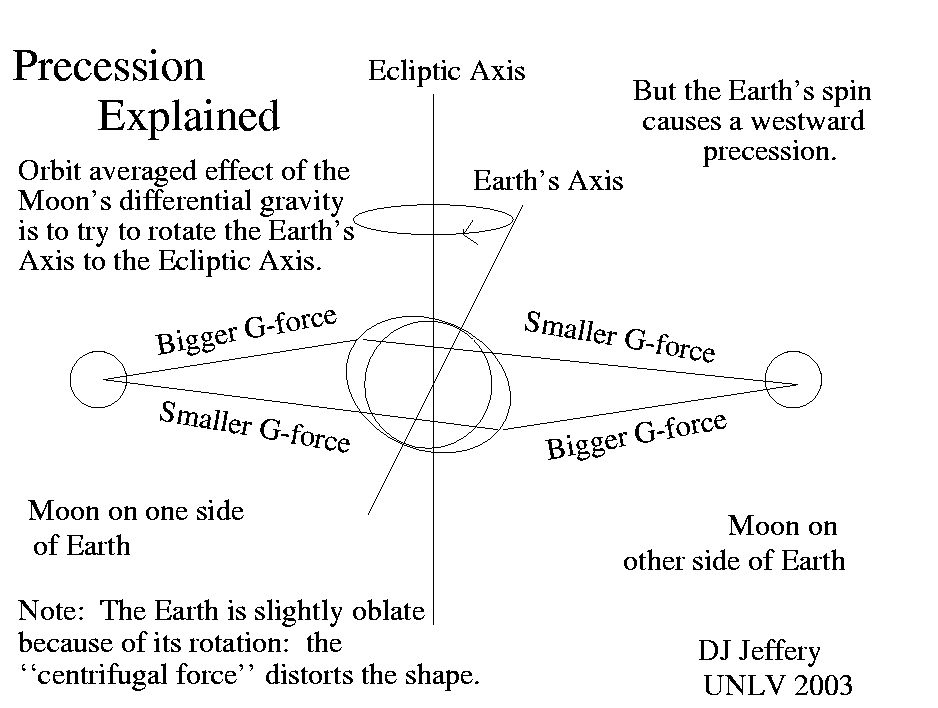
Figure: The physics of the Earth's axial precession
Caption: How the Earth's equatorial bulge and Earth's axial rotation leads to the axial precession.
Further explication:
- The short explication for the
Earth's axial precession
is that the
axial precession
is caused by the
Earth's axial rotation
in combination with
the tidal force
(in order decreasing importance)
the Moon,
the Sun,
and, to a much lesser degree, the other
Solar-System bodies
on the Earth's
equatorial bulge
(see Wikipedia: Axial precession: Cause)
which are in turn caused by the
Earth's axial rotation.
- Now for the long explication.
- The Earth is actually NOT exactly round:
it is a slightly oblate spheroid:
i.e., it is slightly oblate
in that it has an equatorial bulge
due to the centrifugal force
caused by the Earth's rotation.
The centrifugal force pulls
the equatorial region outward causing aforesaid
equatorial bulge.
The oblateness is NOT very large: the Earth equatorial radius R_eq_⊕ = 6378.1 km and the Earth polar radius R_po_⊕ = 6356.8 km: the difference is only 21.3 km (see Wikipedia: Earth Table; Wikipedia: Earth: Shape; Wikipedia: Earth's radius). The flattening ratio is
f = (a-b)/a = 0.0033528 = 1/298.257222101 ,
where a is the semi-major axes and b is semi-minor axis of the oblate spheroid Earth: i.e., respectively, Earth equatorial radius and Earth polar radius (see Wikipedia: Earth Table). - The slightly different gravitational forces
(i.e., the
differential gravitational force)
on the different parts of the
equatorial bulge
of the Earth
(stronger on the near side to the source of external
gravity,
weaker on the far side to the source of external
gravity)
of the Moon,
Sun, and
and, to a much lesser degree, the other
Solar-System bodies
try to align approximately the
equatorial bulge
with the
ecliptic plane,
and thereby align approximately the
Earth's axis
with the ecliptic axis.
The differential gravitational force, in fact, the tidal force.
-
The tidal force
in this case
causes a torque in the
physics terminology.
A torque is a force-like quantity
used to describe the "twisting" effect of a force.
For example, people sometimes talk of torquing a screw.
-
If the Earth were
NOT rotating (but magically still had
an equatorial bulge), the
Earth's axis
would tend to oscillate (at least for some
initial conditions
yours truly thinks)
in the plane
of the illustration if the outside
gravitational forces
were magically just where they are
in the plane of the image.
The oscillation might be damped out in in time due to other perturbations leading to approximate alignment of the Earth's axis and the ecliptic axis.
- But the Earth is rotating
on its axis.
The Earth's rotation is the cause of the equatorial bulge via the centrifugal force as aforesaid.
- With rotation, one gets
NOT oscillation, but a
axial precession.
See the figure below
(local link /
general link: axial_precession.html).
- There seems NO simple way to understand why there is axial precession or precession in general. Precession just defies any in-words explanation.
However, the situation is somewhat similar to why orbiting objects do NOT fall inward under gravity.
They keep falling, but keep missing because they have a sideways motion or, in physics terminology, angular momentum (which is a measure of rotation).
Similarly, the axis of rotating Earth keeps trying to align perpendicular to the direction of gravity, but keeps missing because the Earth has angular momentum about its axis
The "missing" is the axial precession.
- Precession is just very tricky. But it is quite commonly seen.
For example, precession is exhibited by toy tops. See the figure below (local link / general link: precession_toy_top.html).
- Yet another interesting example of precession is provided by bicycles. When the wheels are vertical and rotating there is NO precession. But there is still the stabilizing effect that comes with having angular momentum which is a measure of rotation. Angular momentum is actually a pseudovector aligned with the axis of rotation. Trying to change the direction of angular momentum requires a torque which requires a twisting force which takes an effort and hence the stabilizing effect of angular momentum.
- There seems NO simple way to understand why there is axial precession or precession in general. Precession just defies any in-words explanation.
Credit and file tracking information follows to the divider line:
Credit/Permission: © David Jeffery, 2003 / Own work.Image link: Itself.
Local file: local link: axial_precession_physics.html.
File: Celestial sphere file: axial_precession_physics.html.