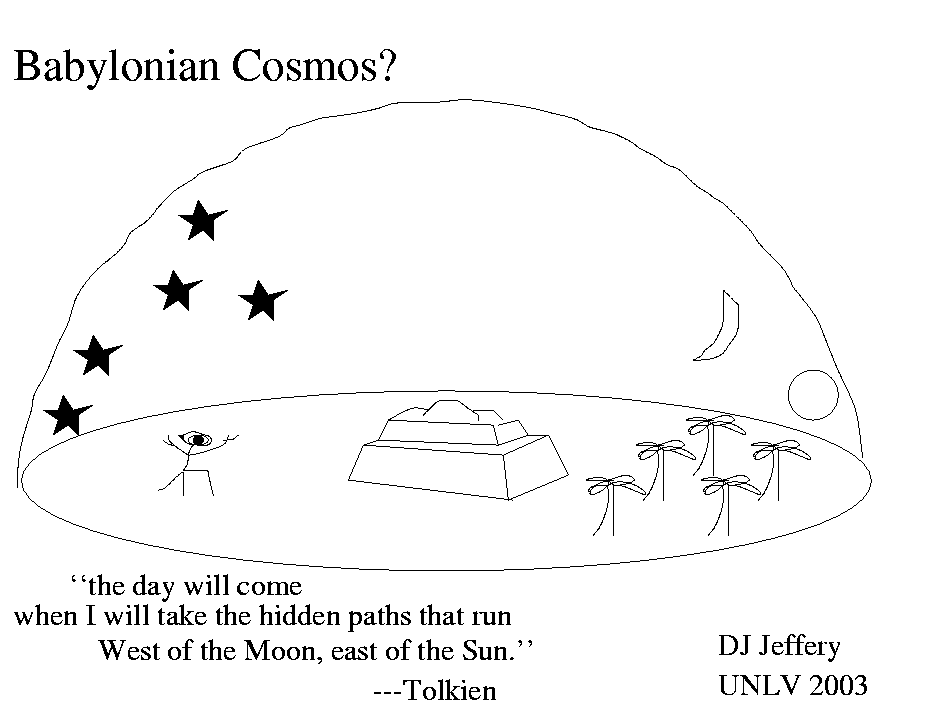
Figure: Ancient Babylonian astronomers and why we have 360° in the circle
Caption: The ancient Babylonian astronomers circa 500--300 BCE divided the circle in 360 units which we call degrees (°) (see Ne-25 or Otto Neugebauer 1969, The Exact Sciences in Antiquity, p. 25; Wikipedia: Degree (angle): History).
They did NOT tell us why 360°, but we can guess at 3 reasons, some weighted combination of which were probably important to them as to why the degree as defined was a good natural unit:
- The year
however counted
(e.g.,
Julian year = 365.25 days
exactly by definition,
solar year = 365.2421897 days (J2000);
sidereal year = 365.256363004 days (J2000),
etc.)
is ∼
360
days.
By choosing
360°
in the circle,
the
angular velocity ω
of Sun on the
celestial sphere
works out to be very nearly
1
degree/day.
(To be exact,
angular velocity ω
= 0.985626 ...
degree/day
for the
Julian year (J2000).)
With a good approximate
angular velocity
of 1
degree/day,
it is easy to calculate
Sun movements approximately
and mentally estimating them is easy too.
So for
Sun tracking purposes, the
degree is a good
natural unit.
Note the Babylonian astronomers would NOT have wanted to make the degree yield exactly (to within their uncertainty) a solar angular velocity of 1 degree/day since that would have divided the circle into an inconvenient non-integer number of degrees. Inconvenient for mental understanding and for simple calculations including especially division.
Why did the Babylonian astronomers want especially to keep track of the position of the Sun on the celestial sphere? Oh, astrology. If the Sun is in a particular zodiac sign at the time of your birth, then that is your zodiac sign and your whole life story can be previewed---for a fee.
- The Babylonian astronomers
(and Babylonian mathematicians too,
of course)
for
mathematics and
astronomy used
a sexagesimal system (base-60 system)
(which has 12
divisors:
1,
2,
3,
4,
5,
6,
10,
12,
15,
20,
30,
60)
and
NOT a decimal system (base-10 system)
which they used probably mostly in
everyday life---counting
on the old fingers, you know.
So obviously dividing the circle into a multiple of their sexagesimal base 60 would have been convenient for calculations.
In one sense dividing the circle into 60 units would be the most consistent choice.
But such an angular unit would be unconveniently large for precise astronomy and would need sub-units even for approximate work.
So the obvious convenient division was into 360 units which gives units that are small enough without being too small and which give an angular velocity of close to 1 degree/day which satisfies the first reason given above.
Also 360 is a conveniently 6 times the sexagesimal base 60. The number 6 is closely related to the sexagesimal base 60 (it's 60 divided by 10) and has 4 highly useful divisors itself: 1, 2, 3, 6.
Note that the sexagesimal system came into use circa 2000 BCE (see Wikipedia: Babylonian numerals: Origin), and so was NOT chosen to get a good base system for Babylonian astronomy: it just worked out that way fortuitously.
Would the Babylonian astronomers have chosen to the divide the circle into a multiple of their base 60 even if days in the year had NOT been close to any such multiple? Who knows. It might have depended on chance or on some weighting of advantages that we do NOT know of.
- Since 360 has
24
divisors
divisors
(including the first 6
positive
integers),
division
with 360
is often easy.
Thus, in arithmetic
with angles, dividing the
circle
into 360°
is a great simplification
since the result of many common
division
operations is often a
whole number: i.e.,
a number with
NO trailing
digits
in a decimal fraction.
So even if the Babylonian astronomers had NOT used a sexagesimal base system, dividing the circle into 360° would have been convenient.
See Table: The 24 Divisors of 360 below.
Table: The 24 Divisors of 360
  Count       small     large
      2           1       360
      4           2       180
      6           3       120
      8           4        90
     10           5        72
     12           6        60
     14           8        45
     16           9        40
     18          10        36
     20          12        30
     22          15        24
     24          18        20
Credit and/or file tracking information follows to the divider line:
Image link: Itself.
Local file: local link: babylonian_360_degrees.html.
Extended file: Babylon file:
babylonian_360_degrees_4.html.
Alternate extended file: Babylon file:
babylonian_360_degrees_5.html.
File: Babylon file:
babylonian_360_degrees.html.
