-
The
large-scale structure of the universe
is the structure formed by
galaxies
(including absolutely postively their
dark matter halos)
treated as the smallest units---but one has to go to smaller scales too to understand how
galaxies act and evolve.
The large-scale structure includes galaxies, galaxy groups (see the figure of Seyfert's Sextet above: local link / general link: seyfert_sextet.html; and below: local link / general link: seyfert_sextet.html), galaxy clusters, galaxy superclusters, galaxy filaments, galaxy walls, voids, and whole lot more.
The study of the large-scale structure is considered part of cosmology, but it is at a level just below that of the observable universe as a whole---which we will study in IAL 30: Cosmology.
-
We need to orient ourselves a bit in the
observable universe.
There are some units and distance scales that it is convenient to note or recapitulate for a start. See the listing in the insert below (local link / general link: astronomical_distances_larger.html).
Now what we can see of the
observable universe
(with
observable universe radius = 14.3 Gpc)
is a sphere centered on us.
To explicate, see the artist's conception of the observable universe in the figure below (local link / general link: cosmos_logarithmic_map.html).
To further explicate the observable universe, consider the 2 artist's conceptions of it in the figure below (local link / general link: observable_universe_cartoon.html).
What is the observable universe
made of? See the figure below
(local link /
general link: pie_chart_cosmic_energy.html).
-
Galaxies are NOT the largest structures.
- Gravitationally Bound or NOT:
Galaxy groups and galaxy clusters are probably mostly gravitationally bound: i.e., they will NOT expand with the expansion of the universe. On the other hand, galaxy superclusters though gravitationally interacting are probably mostly NOT gravitationally bound. In most cases, most of their component galaxy groups and clusters and field galaxies will move apart forever with the expansion of the universe---provided the Λ-CDM model or some other forever expanding cosmological models is true.
Note, velocity dispersion (σ) is a sort of average of the absolute values of the velocities of a set of astro-bodies (relative to their mutual center of mass) forming a gravitationally-bound system. The kinetic energy of the astro-bodies holds them up from collapse to the center of mass under their own self-gravity.
- Galaxy Groups:
The structure just above galaxies themselves are galaxy groups.
Characteristics of galaxy groups (see Wikipedia: Galaxy group: Characteristics):
- ⪅ 50 galaxies of Milky-Way luminosity (∼ 10**10 L_☉) or brighter (see Wikipedia: Galaxy group). There may be tens or hundreds of dwarf galaxies???---it is hard do a census of them since they are small and dim.
- Size scale ∼ 1--2 Mpc.
- Velocity dispersion (σ): ∼ 150 km/s. Recall, velocity dispersion (σ) is a sort of average of the absolute values of the velocities of a set of astro-bodies (relative to their mutual center of mass) forming a gravitationally-bound system.
- Mass ⪅ 10**14 M_☉ ≅ 100*(golden mass ≅ 10**12 M_☉) (Ci-165). This mass includes dark matter.
- Baryon fraction (i.e., the mass ratio of baryonic matter to baryonic matter plus dark matter) is in the range 8--13 % (Ci-165,174--175). The baryon fraction tends to increase with mass.
- Galaxy groups are the commonest grouping of galaxies in the local universe.
- ∼ 50 % of galaxies in the local universe are in galaxy groups.
- No one suggests that galaxy groups have a meaningful analogue to the brightest cluster galaxies (BCGs) that galaxy clusters have in general. Also, they do NOT have in all/most cases a meaningful analogue to Intracluster medium (ICM) that galaxy clusters have in general.????
- Galaxy groups are probably mostly gravitationally bound.???
- Some folks (like yours truly) just consider galaxy groups as VERY POOR galaxy clusters. It saves one from have to say galaxy groups and clusters all the time tediously.
Our own Milky Way belongs to a galaxy group with the inspiring name of the Local Group.
The Local Group is a very poor galaxy group: it has only 3 large galaxies.
A map of the Local Group is shown in the figure below (local link / general link: local_group.html).
-
Question: In what constellation is the
Local Group member the
Canis Major Dwarf Galaxy
(a dwarf elliptical galaxy)?
- Canis Major, the Big Dog.
- Canis Minor, the Little Dog.
- Draco, the Dragon.
- Pegasus.
Answer 1 is right.Talk about gifts.
- Galaxy Clusters:
The structure just above galaxy group is galaxy cluster.
The basic characteristics of galaxy clusters (see Wikipedia: Galaxy Cluster: Basic properties and Wikipedia: Galaxy Cluster: Composition):
- Mass (counting dark matter): ∼ 10**14--10**15 M_☉ (Ci-165). So 100 to 1000 times the golden mass ≅ 10**12 M_☉.
- Baryon fraction (i.e., the mass ratio of baryonic matter to baryonic matter plus dark matter) is in the range 12--16 % (Ci-165,174--175). The baryon fraction tends to increase with mass. Note, the observable universe has the overall universal baryon fraction 16 %, and so only the largest galaxy clusters approach the universal baryon fraction (Ci-27,174-175).
- Size scale: ∼ 1--5 Mpc.
- Velocity dispersion (σ):
∼ 1000 km/s.
Recall, velocity dispersion (σ) is a sort of average of the absolute values of the velocities of a set of astro-bodies (relative to their mutual center of mass) forming a gravitationally-bound system. - A brightest cluster galaxy (BCG)
is definitionally just the
brightest galaxy
in a galaxy cluster.
However,
brightest cluster galaxies (BCGs)
are usually
giant ellipticals,
D giant elliptical galaxies,
or cD giant elliptical galaxies,
and are usually close to the
centers of mass
their host
galaxy clusters.
- There are 3 main components in
galaxy clusters:
- ∼ 50--few 1000s galaxies. But is this counting all dwarf galaxies????. Probably NOT, but it is hard to find reference to say this.???? The galaxies (including their dark matter) contribute only ∼ 1 % of the galaxy cluster mass (see Wikipedia: Intracluster medium: Composition).
- Intracluster medium (ICM): This is a hot totally ionized gas (i.e., a hot extreme plasma) that permeates a galaxy cluster. The gas probably mostly has the primordial cosmic composition (which is also almost cosmic present intergalactic medium composition: fiducial values by mass fraction: 0.75 H, 0.25 He-4, 0.001 D, 0.0001 He-3, 10**(-9) Li-7), but is typically enriched in the range 1/3 to 1/2 of the solar composition (fiducial values by mass fraction: 0.73 H, 0.25 He-4, ∼ 0.02 metals) in metals (including iron (Fe, Z=26)) ejected from galaxies by supernovae (SNe) and AGN feedback (see Wikipedia: Intracluster medium: Composition). The ICM is ∼ 10 % of the galaxy cluster mass (see Wikipedia: Intracluster medium: Composition). The ICM has temperatures in the range 10**7 to 10**8 K (see Wikipedia: Intracluster medium). The high temperatures are due to AGN feedback and/or shock heating from galaxy mergers plus slow cooling (see Wikipedia: Intracluster medium: Heating).
- Dark matter: It contributes ∼ 84--88 % of a galaxy cluster mass (see Wikipedia: Intracluster medium: Composition; Cimatti 2020, p. 165,174).
- There are 3 types of
galaxy clusters which are somewhat vaguely specified:
- Galaxy groups if you consider them as VERY POOR galaxy clusters. They contain ⪅ 50 galaxies of Milky-Way luminosity or brighter. Probably NOT counting dwarf galaxies????. See subsection Galaxy Groups above.
- POOR galaxy clusters: from galaxy group size to a few hundreds of galaxies. Probably NOT counting dwarf galaxies????.
- RICH galaxy clusters: from > POOR galaxy cluster population to thousands of galaxies. Probably NOT counting dwarf galaxies????.
Galaxy clusters are also divided into REGULAR CLUSTERS which are roughly spherically symmetric with a concentration of galaxies in the center and IRREGULAR CLUSTERS which are irregular (FK-593).
As usual, there is actually a continuum between the types of galaxy clusters.
Also since the specifications are a bit vague, which category a galaxy cluster falls into will vary a bit with reference.
For an example of a RICH galaxy cluster, see the Coma Cluster in the figure below (local link / general link: galaxy_cluster_coma.html).
- Probably, most galaxies are located in galaxy clusters (here counting galaxy groups as VERY POOR galaxy clusters???): see B. Ryden: Clusters and Superclusters.
How many? Someone must have good statistics, but NOT yours truly. However, within 5 Mpc of the Milky Way ∼ 80 % of galaxies are in galaxy groups and clusters (see Wikipedia: Field galaxies).
POOR galaxy clusters far outnumber rich ones (FK-592) and most galaxies are NOT in rich clusters????.
Galaxies NOT in galaxy groups and clusters (i.e., isolated galaxies) are called field galaxies.
- In fact, the number of galaxies in a galaxy cluster or galaxy group is often hard to determine since there are many dwarf galaxies (e.g., dwarf elliptical galaxies) that are hard to find (FK-594). In the Coma Cluster (see figure above: local link / general link: galaxy_cluster_coma.html), there are thousands of dwarf galaxies which we are only made obvious by imaging in the infrared.
Also galaxy groups and galaxy clusters have NO sharp edges.
This last comment applies both to the galaxy distribution in galaxy clusters and the dark matter in galaxy clusters which makes most of their mass.
- The galaxy clusters appear to be mostly gravitationally bound systems (FK-594).
-
Question:
Gravitationally bound
means that the component objects of
systems
so described:
- CANNOT move indefinitely far apart without some extra kinetic energy. Their mutual gravitational attraction holds them in a group.
- are experiencing a mutual gravitational attraction.
Both answers are right, but answer 1 is a more complete answer.Of course, complex interactions among objects in a gravitationally bound system may impart sufficient kinetic energy to individual objects to allow them to escape. In fact, on a long enough time-scale a chaotic gravitationally bound system will gradually disperse completely: objects chaotically gain enough kinetic energy to escape, leaving the others more tightly bound, but always with enough kinetic energy to allow more escapes until all that is left is a 2-body system which in Newtonian physics if completely isolated is eternally stable and repeating clockwork. There may be rarely eternally stable stable n-body systems in Newtonian physics. The tendency of gravitationally bound multi-body systems to continuous escapes can be called "gravitational-system evaporation"
Gravitational perturbations from outside gravitationally bound multi-body systems can also lead to escape.
- The neareast RICH galaxy cluster is the Virgo Cluster.
Now yours truly knows what you are thinking---"that's in Virgo"---well it straddles the line between the constellations Virgo and Coma Berenices.
A sky map of constellation Virgo (with the Virgo Cluster shown) is shown in the figure below (local link / general link: iau_virgo.html).
- Galaxy Superclusters:
Galaxy clusters can themselves be part of superclusters that can contain tens of galaxy clusters and have a size scale of 50 Mpc (FK-594). Yours truly believes they are all irregular in shape.???
Superclusters although gravitationally interacting appear to be mostly NOT gravitationally bound (FK-594). In most cases, most of their component galaxy groups and clusters and field galaxies will move apart forever with the expansion of the universe.
We take up the expansion of the universe in IAL 30: Cosmology.
The Local Group belongs to the Virgo Supercluster which itself is part of the Laniakea Supercluster.
-
Question: Where is the
center of mass
on the sky of the
Virgo Supercluster? Probably in or near
constellation:
Just judging by the name answer 3.
This is right. The center of mass is near the Virgo Cluster (Wikipedia: Virgo Supercluster: Galaxy distribution).
The Virgo Supercluster, Laniakea Supercluster (sans name), and the local large-scale structure of the universe are shown in the figure below (local link / general link: large_scale_structure_z_0x035.html).
- The Large-Scale Structure of the Universe:
Galaxies and larger groupings collectively are called the large-scale structure of the universe.
The larger structures include galaxy groups, galaxy clusters, galaxy superclusters, galaxy filaments (string-like bands of galaxies and larger groupings), galaxy walls (walls of galaxies and larger groupings), and (cosmic) voids (low density of galaxies). Collectively, galaxies and these larger structures are often referred to as the cosmic web which is essentially a descriptive synonym for the actual existing (as opposed to a just hypothetical) large-scale structure of the observable universe.
-
To explicate "descriptive synonym":
The 3-dimensional appearance of the
large-scale structure of the universe
is cobwebby
in the eyes of many
(FK-596;
CK-396),
and hence the name
cosmic web
has come into common use.
The study of the large-scale structure is actually considered part of cosmology.
The local large-scale structure or cosmic web is illustrated in four figures below:
- Figure 1 of the local
large-scale structure:
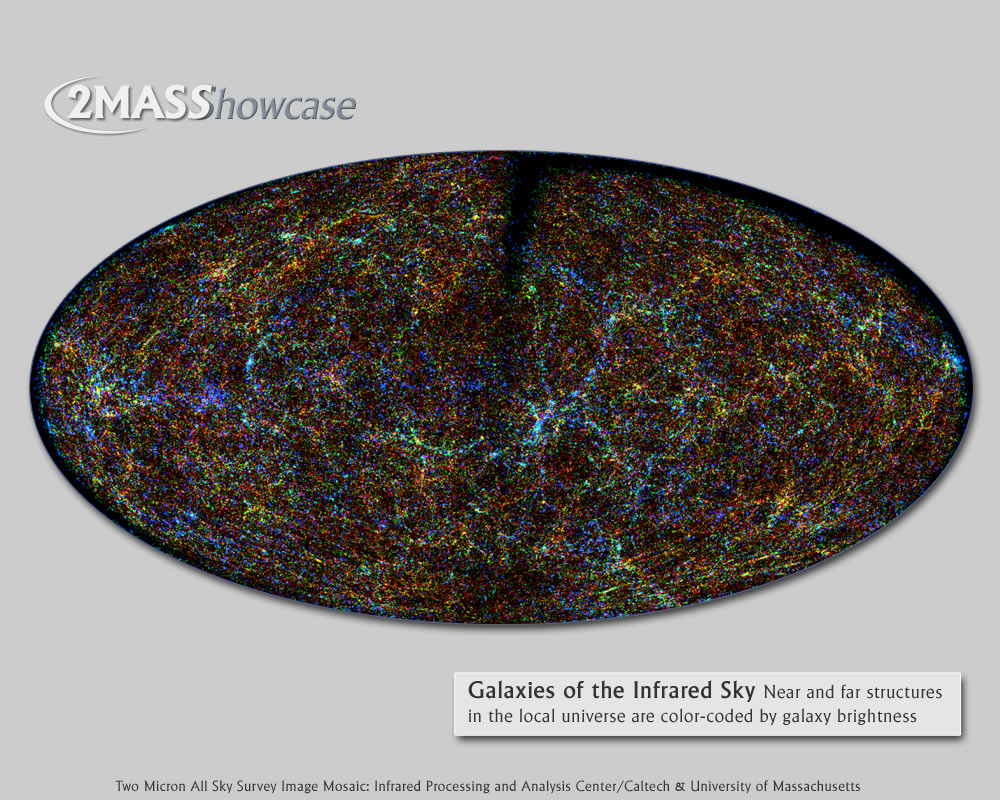
Caption: All sky galaxy map at 2.2 microns.
This map shows about 1.6 million galaxies in the nearby universe detected at 2.2 microns in the near infrared.
The image is in Hammer projection (2:1 axis ratio with the long axis corresponding to the equator or equator-like line), yours truly suspects. This maps a spherical surface into an 2:1 ellipse. The shapes of regions are distorted, but their areas are accurate in some fastion.
The brightest galaxies are in blue and thus are mostly nearby.
Faintest galaxies are in red, and thus are mostly relatively far away.
Green and yellow are somewhere in between, but the official caption is NOT specific.
The color scheme thus gives representation of the 3-dimensional large-scale structure.
The filaments, voids, and foamy nature of the large-scale structure of the universe are made somewhat visible in the image.
The untrained eye finds galaxy clusters, but superclusters of galaxies are harder to recognize.
There is a dark band that mostly lies on the edge of this image with a spur at the top center. This the band where Milky Way disk of star and dust blocks our view. The dark band is just an omission of sources.
Credit/Permission: 2MASS/T. H. Jarrett, J. Carpenter, & R. Hurt, University of Massachusetts, Infrared Processing and Analysis Center/Caltech, NASA, NSF, before or circa 2004 / Public domain.
Acknowledgment: "Atlas Image [or Atlas Image mosaic] obtained as part of the Two Micron All Sky Survey (2MASS), a joint project of the University of Massachusetts and the Infrared Processing and Analysis Center/California Institute of Technology, funded by the National Aeronautics and Space Administration and the National Science Foundation. This is the stated policy of 2MASS."
Download site: Wikimedia Commons: File:Galaxies of the Infrared Sky .jpg.
Image link: Itself.
- Figure 2 of the local
large-scale structure
(see the figure below
(local link /
general link: local_universe_ir.html):
- Figure 3 of the local large-scale structure:
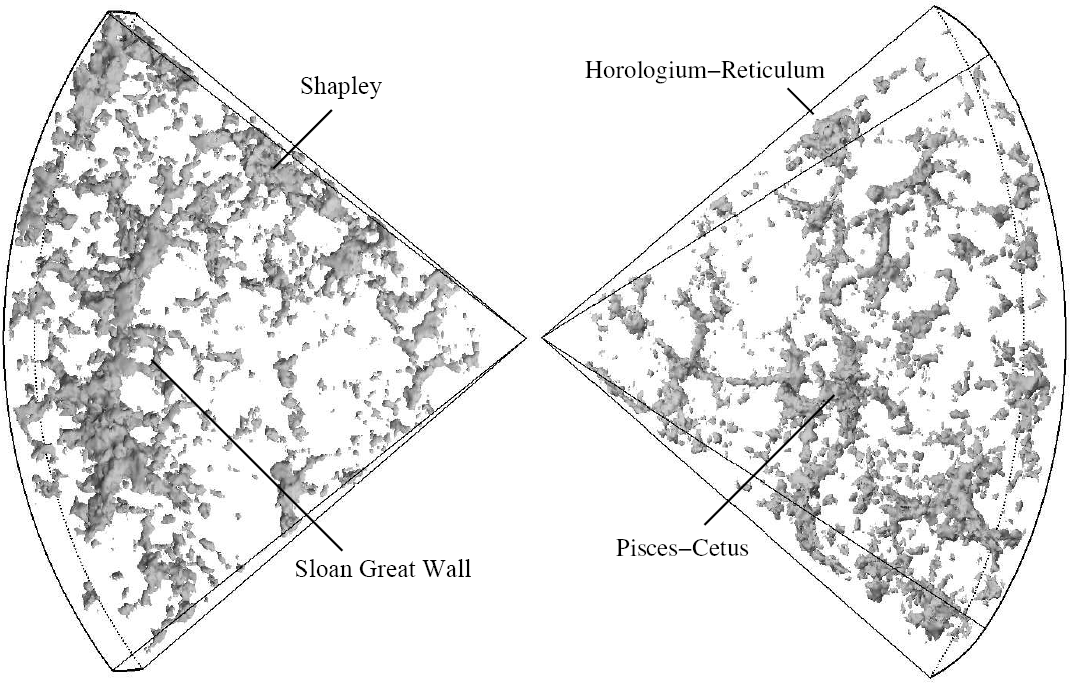
Caption: "Three-dimensional DTFE reconstruction of the inner parts of the 2dF Galaxy Redshift Survey. The figure reveals an impressive view on the cosmic structures in the local universe. Several galaxy superclusters stand out, such as the Sloan Great Wall, the largest structure in the observable universe known as of circa 2007." (Slightly edited.)
The image shows two slices through the sphere of the observable universe.
The dense regions of galaxies are represented by gray shading and the less dense regions or voids by white space.
The foamy, sudsy, filamentary nature of the large-scale structure is illustrated.
The Sloan Great Wall is about 300 Mpc away and is about 400 Mpc in length. These value indicate the size of the slices being shown.
Remember that the Hubble length = L_H = c/H_0 = 4.2827 Gpc/h_70 = 13.968 Gly/h_70, and so the Sloan Great Wall, although considered nearby, is still a fair fraction of a Hubble Length away.
-
h_70 = H/(70 (km/s)/Mpc), where H_0 is the
Hubble constant
(the rate of expansion of the universe
per unit length).
Currently, H=70.4(1.4) (km/s)/Mpc is about the best determination of the Hubble constant (see Wikipedia: Concordance model: Parameters).
However, since the best Hubble constant value fluctuates with time, it is convenient to adopt 70 (km/s)/Mpc as a fiducial value and write quantities that depend on the Hubble constant in terms of h_70. Hubble constant itself written this way is H=70*h_70 (km/s)/Mpc.
Recall that the Hubble length = L_H = c/H_0 = 4.2827 Gpc/h_70 = 13.968 Gly/h_70, is a characteristic size scale for the observable universe within the expanding universe paradigm that is indepdent of specific models (e.g., the Λ-CDM model).
Note, the observable universe radius = 14.3 Gpc in the Λ-CDM model with about the best available parameters (see Wikipedia: Observable universe).
Credit/Permission: © Willem Schaap (AKA User:Wschaap), 2007 (uploaded to Wikipedia by User:Zoe0, 2009) / Creative Commons CC BY-SA 3.0.
Image link: Wikipedia: File:2dfdtfe.gif.
- Figure 4 of the local large-scale structure (see the figure below (local link / general link: large_scale_structure_z_0x035.html).
- Figure 3 of the local large-scale structure:
-
Group Activity:
Form groups of 2 or 3---NOT more---and tackle Homework 29 problems 2--5 on galaxies, large scale structure, and galaxy formation.
Discuss each problem and come to a group answer.
Let's work for 5 or so minutes.
The winners get chocolates.
See Solutions 29.
- Galaxy Groups:
To recapitulate, there is the large-scale structure (of the observable universe) which includes galaxies, galaxy groups (see the figure of Seyfert's Sextet above: local link / general link: seyfert_sextet.html), galaxy clusters, galaxy superclusters, galaxy filaments, galaxy walls, voids, and whole lot more.
-
Note, the term
cosmic web
is nowadays often used as a synonym for
large-scale structure
including by yours truly.
However, pedantically (which we will NOT be), the
cosmic web
is the particular
large-scale structure
the observable universe actually exhibits,
and NOT other possible
large-scale structures
such as those considered in the past
(e.g., the
hierarchical universe (Bo-13,14,19).
In section Large-Scale Structure Formation and Evolution, we will discuss structure formation (i.e., the formation and evolution of the large scale structure of the observable universe).


- Cosmological Principle Explicated:
The cosmological principle is explicated in the figure below (local link / general link: cosmological_principle.html).
- No End of Greatness?:
It was once wondered if there was NO limit to structure---NO End of Greatness. That one would keep finding structure on larger scales.
To explicate, say galaxy superclusters were grouped into Type II superclusters which were grouped into type III superclusters which were ... and so on forever. There would be NO End of Greatness and the mean mass-energy of the universe would go to zero if there were no mass-energy between galaxies. This cosmological model was considered once and was called the hierachical world model (Bo-14--15,19).
A hierachical world model could even be a fractal.
A fractal is a thing that is or looks the same on all or many scales at least in some approximation. The branches and roots of trees are approximate fractals.
For example, one can make a fractal by drawing an iteration of 3 branches from each branch.
The animation in the figure below (local link / general link: fractal_koch_snowflake.html) illustrates the construction of a fractal.
But the observable universe is NOT a fractal nor any other kind of hierachical world model so far as we can tell.
Also, so far as we can tell, the observable universe obeys the cosmological principle: i.e., the assumption that on a large enough distance scale the observable universe is homogeneous (same in all places) and isotropic (same in all directions).
But there is NO sharply-defined distance scale for the size of the largest structures. However, it is still useful to have a fiducial cosmological principle size scale and the Yadav scale = 370/h_70 Mpc (where reduced Hubble constant h_70=H_0/(70 km/s/Mpc)) can be adopted. It has some theoretical justification (Wikipedia: Cosmological principle: Violations of homogeneity).
For further explication of the cosmological principle, see Cosmology file: cosmological_principle.html.
- No End of Greatness?:
-
We discuss
structure formation
(i.e., the formation of the
large scale structure
of the observable universe or the
cosmic web)
in the insert below
(local link /
general link: large_scale_structure_formation_outline.html).
Form groups of 2 or 3---NOT more---and tackle
Homework 29
problems 2--8 on
galaxies,
large scale structure,
and
galaxy formation.
Discuss each problem and come to a group answer.
Let's work for 5 or so minutes.
The winners get chocolates.
See Solutions 29.
Group Activity: