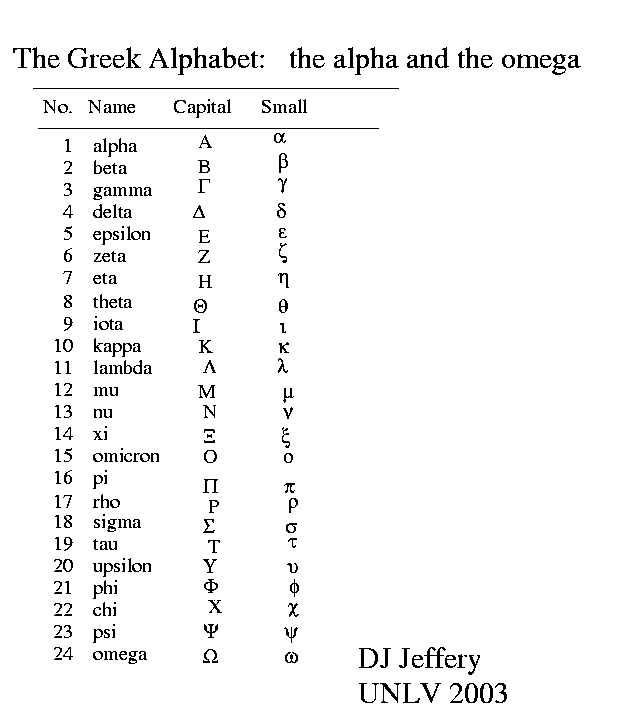
 Figure: The Greek alphabet use in astronomy explicated
Caption: The Greek alphabet of 24 Greek letters: alpha α, beta β, gamma γ, ...
-
alpha,
beta, ... --- you get it?
- α,
β,
γ,
and
δ turn up
in
Bayer designation system for
bright stars
and in designating the
hydrogen Balmer lines.
-
θ is the conventional symbol
for angle.
- λ is the conventional symbol
for wavelength.
- μ is the
metric prefix meaning 10**(-6).
- π the letter
is the symbol for the
irrational number
Pi: π = 3.14159265358979 ...
(see One Million Digits of Pi).
- And others as need arises.
- Actually all small Greek letters
are used in the aforesaid Bayer designation system
to label stars in a given
constellation in order of their
apparent magnitude
(approximately their
apparent V magnitude):
the brightest one was called α,
the 2nd brightest one was called β,
etc.
The ordering by brightness is NOT always correct.
Johann Bayer (1572--1625) and other early
implementers of the Bayer designation system
did NOT work at modern
accuracy/precision.
When these implementers ran out of
Greek letters, they used
Roman letters and in later times
numbers were used too.
So omicron ο is used
astronomy even though it looks
almost like o.
Credit and/or file tracking information follows to the divider line:
Image link: Itself.
Local file: local link: greek_alphabet.html.
File: Hellas file:
greek_alphabet.html.
