
Image 1 Caption: "This artist's impression depicts the paths of photons in the vicinity of a black hole. The capture of light by the event horizon of the black hole and the gravitational lensing of uncaptured light beams around the black hole combine to the cause of the black hole shadow observed by the Event Horizon Telescope (EHT, 2009--)." (Somewhat edited.)
To elaborate on the Image 1 Caption: A black hole event horizon CANNOT be seen directly in accessible observations. What one sees when one can resolve a black hole is the black hole shadow plus any complicating surrounding or background gas, cosmic dust, accretion disks, stars, etc.
Features:
- The DISTANT OBSERVER is far off to the
left in
Image 1.
You can see that light rays passing through an annulus too close to event horizon cross each other and CANNOT reach observer.
Note, Image 1 shows a cross section of a structure with axis ymmetry about the line of sight to the observer, and hence the term "annulus".
As the radius of the annulus is made bigger the crossing point eventually reaches the observer and you can see then that the observer can see objects at angles greater than the opening angle of the cone whose apex is the crossing point at the observer.
Light rays that pass too close to the opening angle are significantly gravitational lensed, and thus are NOT at their apparent angle from the line of sight to the center of the event horizon.
Light rays that are sufficiently far from the opening angle are NOT significantly gravitational lensed, and thus are at their apparent angle (to within measurement error) from the line of sight to the center of the event horizon.
- Image 2 Caption: The black hole shadow is 3*sqrt(3)/2 = sqrt(27)/2 = (2.598 ...) times larger on the sky than the event horizon (whose diameter is 2 times the Schwarzschild radius R_Sch=2GM/c**2) for a Schwarzschild black hole for a DISTANT OBSERVER (see Bisnovatyi-Kogan et al. 2019, "Shadow of black holes at local and cosmological distances", p. 2 and Bisnovatyi-Kogan & Tsupko 2019, "Gravitational Lensing in presence of Plasma: Strong Lens Systems, Black Hole Lensing and Shadow") for which the Schwarzschild radius R_sch = 2GM/c**2 = (2.9532 km)*(M/M_☉) = (19.741 AU)*[M/(10**9*M_☉)].
- The lowest case in Image 2 is what the DISTANT OBSERVER sees for an isolated Schwarzschild black hole: i.e., the black hole shadow: the angular region on the sky from which light CANNOT reach the DISTANT OBSERVER---and so what the DISTANT OBSERVER sees in that angular region is blackness: i.e., the black hole shadow itself.
An observer who is NOT DISTANT will a black hole shadow of different size.
The "2M" in Image 2 is the Schwarzschild radius R_Sch=2GM/c**2 with G/c**2 set to 1. So the diameter of the black hole shadow inferred from the above formula is 2*[3*sqrt(3)/2]*(2M) = 2*3*sqrt(3)*M which is the formula seen in Image 2 for the lowest case.

- Image 3 Caption: "An animation of a plane wave of light that passes by a static black hole and some of the light rays are absorbed. The light rays absorbed are those that have an impact parameter less than the radius R. By the reversibility of light, this means that looking at this sphere is equivalent to looking at the surface of the black hole event horizon. This gravitational lensing causes the black hole shadow to be bigger than event horizon by a factor 3*sqrt(3)/2 = sqrt(27)/2 = (2.598 ...). The photon sphere is also depicted: it is the spherical shell where light rays inside it are orbiting. Light rays entering the photon sphere inevitably enter the event horizon and never get out. However, some orbiting light rays that start within the photon sphere can escape to infinity, and so the photon sphere is NOT like the event horizon from within which nothing escapes to infinity." (Somewhat edited.)
The quoted Image 3 Caption is NOT entirely understood by yours truly. However, Image 3 is essentially a dynamic version of Image 1.
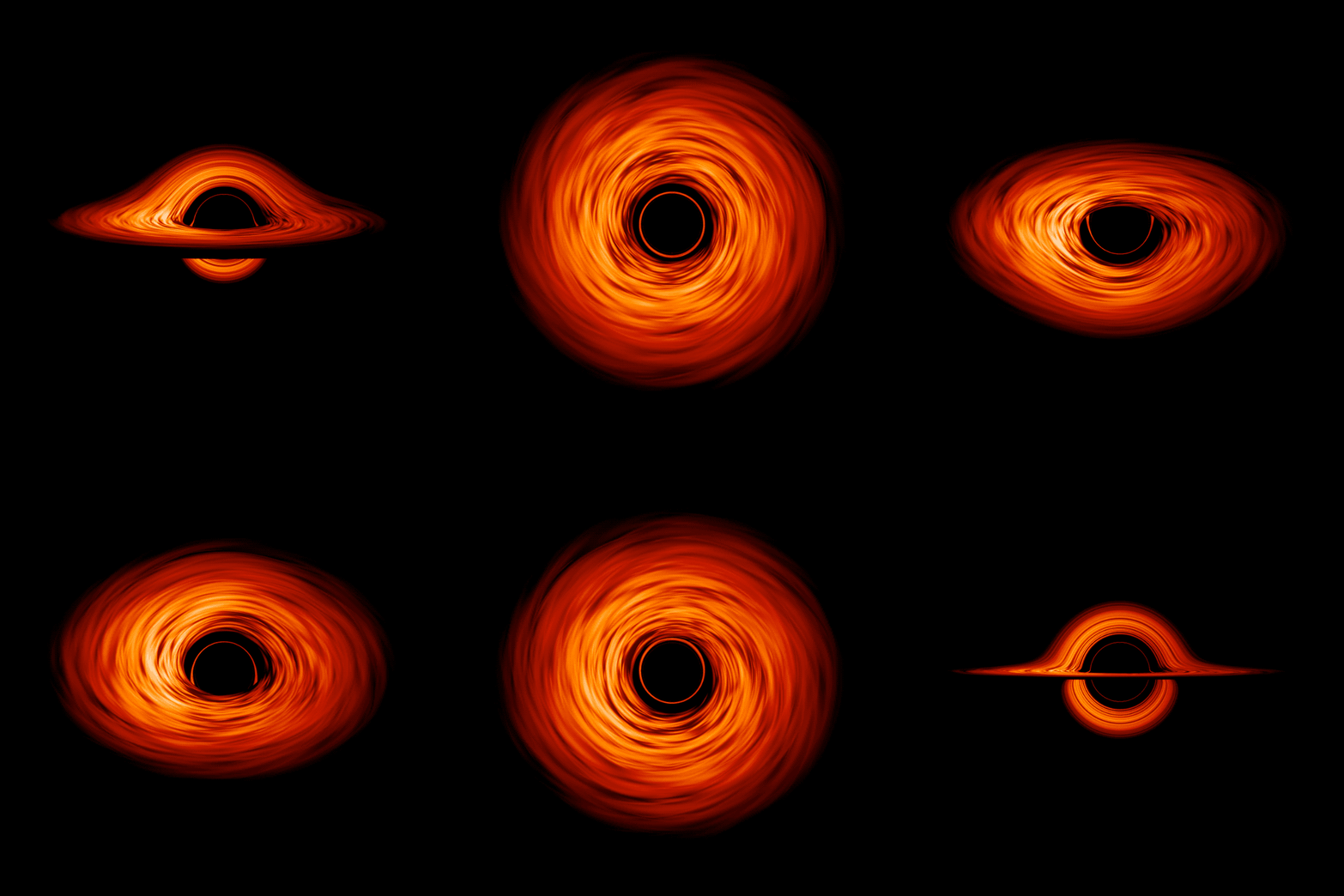
- Image 4 Caption: An animation of a simulated black hole (more exactly, black hole shadow) and its accretion disk from the point of view of an observer circling black hole in a plane perpendicular to the accretion disk. To the circling observer, the accretion disk is revolving on a horizontal axis. The black hole's extreme gravitational field gravitationally lenses in a complex and distorting way the accretion disk, but exactly what is seen depends on viewing angle. The greatest distortion is when the accretion disk is seen edge-on. See File:BlackHoleMovementsmoother.gif for a long description of Image 4.
- Image 2 Caption: The black hole shadow is 3*sqrt(3)/2 = sqrt(27)/2 = (2.598 ...) times larger on the sky than the event horizon (whose diameter is 2 times the Schwarzschild radius R_Sch=2GM/c**2) for a Schwarzschild black hole for a DISTANT OBSERVER (see Bisnovatyi-Kogan et al. 2019, "Shadow of black holes at local and cosmological distances", p. 2 and Bisnovatyi-Kogan & Tsupko 2019, "Gravitational Lensing in presence of Plasma: Strong Lens Systems, Black Hole Lensing and Shadow") for which the Schwarzschild radius R_sch = 2GM/c**2 = (2.9532 km)*(M/M_☉) = (19.741 AU)*[M/(10**9*M_☉)].


-
Images:
- Credit/Permission: Nicolle R. Fuller/NSF,
2019
(uploaded to
Wikimedia Commons
by User:Blueil77,
2019) /
Public domain.
- Credit/Permission: ©
Bisnovatyi-Kogan & Tsupko 2019,
"Gravitational Lensing in presence of Plasma: Strong Lens Systems, Black Hole Lensing and Shadow" /
No permission.
Image link: Bisnovatyi-Kogan & Tsupko 2019, p. 21. Image link: Placeholder image alien_click_to_see_image.html. - Credit/Permission: ©
User:Hugo Spinelli,
2023 /
CC BY-SA 1.0.
Image link: Wikimedia Commons: File:Black Hole Shadow.gif.
- Credit/Permission:
NASA Goddard Space Flight Center
(GSFC) / Jeremy Schnittman,
2019
(uploaded to
Wikimedia Commons
by User:ILVSM,
2023) /
Public domain.
Image link: Wikimedia Commons: File:BlackHoleMovementsmoother.gif.
File: Black hole file: black_hole_shadow.html.