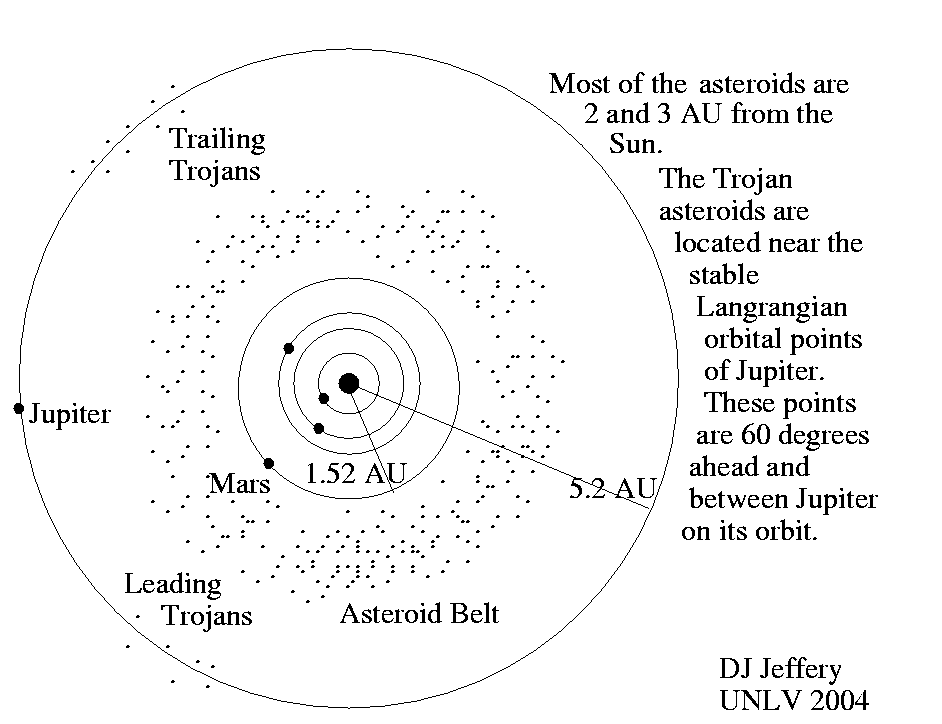
 A cartoon of the Asteroid Belt
(HI-257).
A cartoon of the Asteroid Belt
(HI-257).
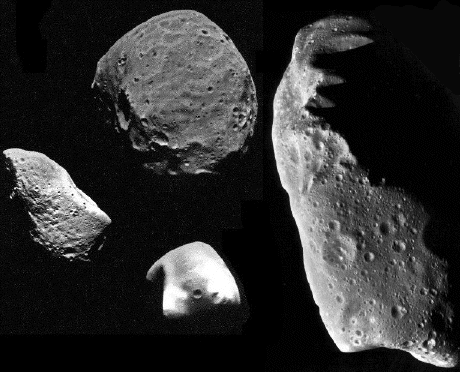 An asteroid collage.
At the right is 951 Gaspra imaged in 1991 by Galileo on its way to Jupiter (Se-563).
At the left may be 243 Ida imaged in 1993 by Galileo (Se-563).
The others I can't identify.
Credit: NASA.
 Growth of known NEAs and NEA+18s (i.e., large NEAs) 1980jan01--2005mar31.
As of 2005apr30, there are:
- 3378 NEOs: i.e., near Earth asteroids and comets.
- 3322 NEAs: i.e., near Earth asteroids.
- 772 NEA+18s: i.e., near Earth asteroids of order or greater
than 1 km in size scale.
- 695 PHAs: i.e., potentially hazardous asteroids: i.e., those
approaching Earth by =< 0.05 AU.
- 151 PHA+18s: i.e., potentially hazardous asteroids of order
or greater than 1 km in size scale.
- 56 NECs: i.e., near Earth comets. The NEC number doesn't grow
very rapidly. There were 40 as of
2000jan01.
The curves in the figure are both still growing.
The NEA curve approximately linearly.
The NEA+18 curve shows a probably significant decline in slope.
Eventually, the NEA+18 curve must plateau when almost all NEA+18s have been found.
Probably finding the very last NEA+18s will take a long time since it takes an exhaustive search to find the very last ones.
There is no end to the number of NEAs since one can keep looking for smaller and smaller ones. But those that are less than 10 m or so (which are are better called meteoroids) probably pose no threat at all.
Credit: NASA/NASA NEO Program/Alan B. Chamberlin.
 2 Vesta: a sequence of images. HST, 1995apr19.
I suppose this shows Vesta rotating, but its hard to tell.
Credit: NASA/HST.
 2 Vesta: direct image, elevation map, model. HST, 1997sep04.
Vesta, the 2nd largest asteroid, has average diameter 523 km. But despite its large size, it isn't all that spherical as one can see.
A large crater with a central peak near the south is clear on the elevation map. The crater has a diameter of about 400 km.
Vesta has basaltic rock, and so is thought to have undergone volcanism and chemical differentiation in the early solar system.
Perhaps many asteroids larger than 100 km underwent some chemical differentiation and volcanism in the early solar system.
But their residual heat of formation and past radioactive heat were lost quickly and they became internal-heat geologically inactive early on.
Vesta and smaller asteroids might have owed their chemical
differentiation and internal heat to aluminum-26 (half-life
about 0.7 Myr) and perhaps other
relatively short-lived radioactive nuclides
(see
Wikipedia: Aluminium-26: Occurrence in the interstellar medium;
).
The short-lived species would have to have been produced by a supernova
that went off shortly before the solar system formation and
that seeded the solar system with its debris.
See Se-565.
Credit:
NASA/HST; download site
Views of the Solar System by Calvin J. Hamilton.
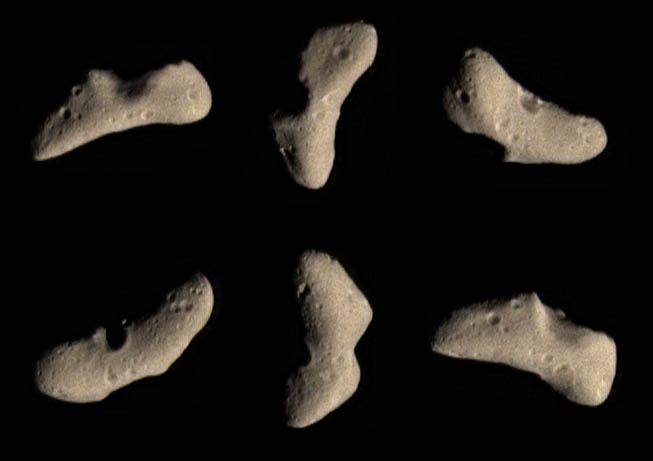
Eros is approximately 33x13x13 km.
Credit: NASA/NEAR probe; download site
Views of the Solar System by Calvin J. Hamilton.
Eros is approximately 33x13x13 km and we are viewing it
from about 1800 km away.
The sequence of images covers 5.5 hours and shows Eros
in approximately the color seen by the unaided eye.
NEAR would go into orbit around Eros and land on it
as the final act of its mission.
You can see that the surface is cratered, but smoothish.
The surface has probably been pulverized to regolith:
slippery, glassy dust with pebbles and rocks of various sizes????.
Eros, discovered in 1898, is a NEA: i.e., a Near-Earth asteroid.
It's semi-major axis is 1.458 AU and it has eccentricity 0.223
(Cox-319).
Answer 2 is right.
Because Eros is named for the love god, many of the features on
Eros have all been named for famous/infamous lovers:
Don Quixote & Dulcinea, Orpheus & Eurydice, Catherine & Heathcliff,
Don Juan, Casanova, Genji, and Lolita
(
Views of the Solar System: Cylindrical Projection
Map of Eros by Grant L. Hutchison).
Credit: NASA/NEAR probe; download site
Views of the Solar System by Calvin J. Hamilton.
This is a false color image of 243 Ida taken on a fly-by by the Galileo
probe on its way to Jupiter in 1993.
North is at 1:00.
The bright blue areas may indicated enrichment in iron-bearing minerals.
Ida is 58 km along its long axis. Dactyl is about 15 km in size scale
(Se-563).
Ida like mostly smaller asteroids is not round. Its self-gravity
is insufficient to pull it into a spherical shape against its
electromagnetic force structure and its centrifugal force due
to its rotation.
Credit:
NASA:
Galileo spacecraft (1989--2003): Image #P-44131.
``This composite image shows the 10.4-magnitude asteroid 14 Irene
as it moves across the sky. It is a combination of four one-minute
exposures spaced about 20 minutes apart.''
Credit:
NOAO/AURA/NSF.
I'm not actually quite sure what we are seeing.
Presumably the horizontal and vertical scales are related to
distance on the sky.
The caption called it a radar image and gave no further explanation.
Credit
NASA/JPL/S. Ostro.
Semi-major axis: 1.69884271 AU.
Eccentricity: 0.507424557.
Inclination to Ecliptic Plane: 12.1843194 degrees
Rotational period about 2.1 hr.
The most threatening object yet found is 1950 DA which was first
discovered 1950feb23 and lost, but was recovered on 2000dec31 (last
evening of the 20th century by the precise definition).
See NASA NEO Program: 1950 DA
and
Minor Planet Center: Apollo asteroids.
1950 DA is a temporary name indicating the year of discovery.
It is asteroid 29075.
1950 DA is about 1.1 km in size scale. So according to the threat
diagram above, it could cause continental devastation.
Under one assumption about its axial tilt 1950 DA has a 1/300 chance
of impacting Earth.
Under another assumption, the chance is practically zero.
So one can average and say a 1/600 chance of hitting.
Why can't we be more certain? All those minute perturbations that
can't be accurately included in a calculation that extends for centuries.
The date of possible impact is 2880mar16---just before St. Patrick's Day,
2880.
So if 1950 DA is going to impact, we have a long time to do something
about it.
What can we do if its going to hit? A small enough perturbation
early on would deflect it. Just a small push perhaps or just
changing its reflectivity by covering it with charcoal soot.
The risk from 1950 DA given its chance of hitting and its size
is thought to be greater than the combined
risk by all other known asteroids through to 2880.
So we can all breathe easier so far.
Credit
NASA/JPL/J. Giorgini.
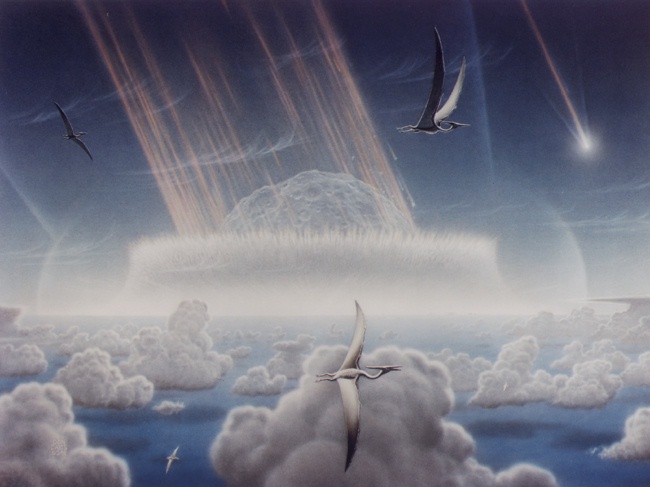
An artist's conception of the Chicxulub impactor at the moment of impact.
In 1980, it was proposed that the mass-extinction 65 million years
at the end of the Mesozoic era/Cretaceous period and
beginning of the Cenozoic era/Paleogene period was caused by
an impactor of order 10 km in size scale.
The initial evidence was
a worldwide layer rich in iridium at the stratigraphic
Cretaceous/Paleogene boundary: iridium is an element rare on Earth,
but common
in some meteorites (Se-573--574).
The mass extinction ended the age of the dinosaurs and began
age when mammals were the dominant large animals.
See Se-573--574;
and Sm-92--93.
The crater of the impactor is
the Chicxulub crater centered near Chicxulub village, Yucatan,
Mexico. It is 170 km in diameter, but is entirely covered by
sediments.
It was discovered in the early 1990s by drilling??? and other
geological means.
It is thought that the impactor threw up a huge plume of hot
debris that spread around the planet and ignited massive
forest fires.
Subsequently, soot from the fires and dust from the debris may
have caused a multi-year global winter.
Both the fires and the multi-year global winter would have
extinguished considerable life.
The world-wide debris included impactor iridium which gave the
iridium-rich layer at the Cretaceous/Paleogene boundary.
That an impactor hit near the end of the Cretaceous is solidly established.
There are, however, still a few
doubters that it was the cause of the mass extinction.
They rebut the leading theory. See
Keller et al., 2003sep25 and
Sm-93.
Credit
NASA/artist Don Davis.
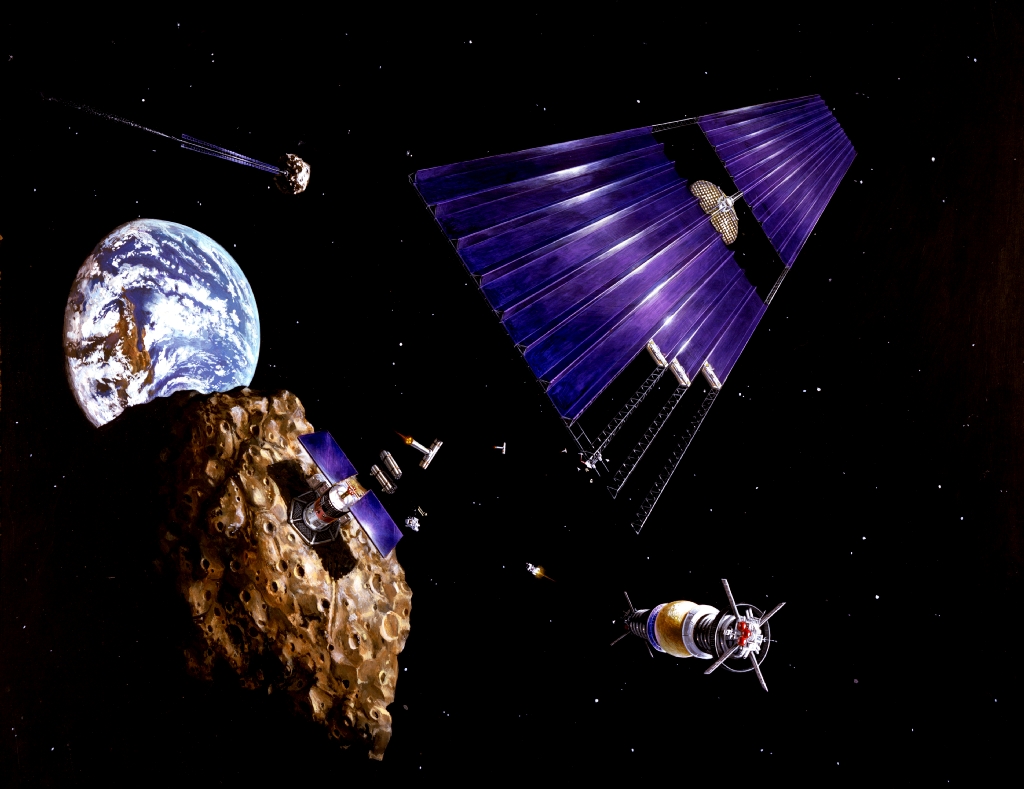
An artist's conception of asteroid mining.
As long ago as 1977 when this illustration was made, NASA has
been considering asteroid mining.
The image caption isn't terribly clear. The lander miner is
is obvious.
But is the large solar array the orbiting construction platform
or just an inset illustration of a solar array?
Credit
NASA/artist concept: Denise Watt.
 433 Eros from the orbiting NEAR probe, 2000feb29.
 433 Eros from the NEAR probe, 2000feb12.
Question: Does Eros every cross Earth's orbit?
perihelion = (1-eccentricity) x a  = about 0.8 x 1.5 = 1.2 AU

           = 1.13 AU more exactly
 Asteroid 243 Ida and its moon Dactyl.
 14 Irene
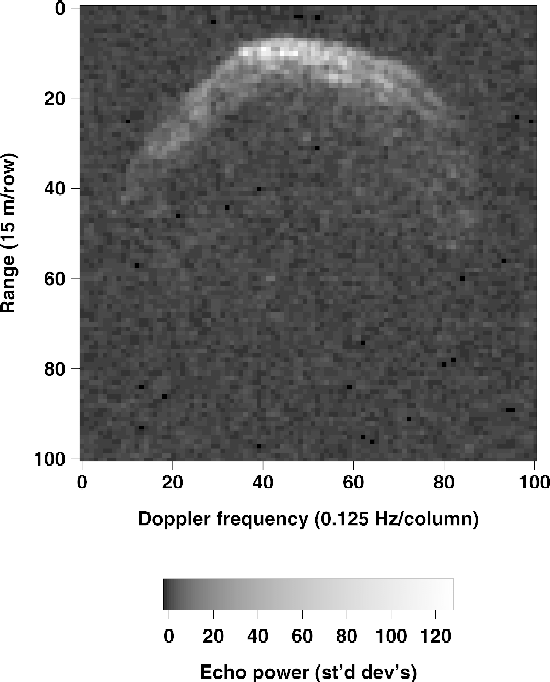 A radar image of 1950 DA (asteroid 29075). Arecibo, 2001mar04.
 The orbit of 1950 DA (asteroid 29075) discovered 1950feb23 by C. A. Wirtanen.
[``World-wide'' doesn't mean the layer is everywhere.
Only where the rock strata for the that epoch survive is the
layer found. But those strata exist at many places around the
globe.]