REU Summer 2004
Student Projects
| Student Information | Photograph | Abstract |
| Brad Clarke of UNLV working with Prof. Victor Kwong on "Stabilizing and Analyzing Ions in a Radio Frequency Quadrupole Ion Trap." |  |
Utilizing Mathieu's second-order differential equation, we wrote a computer program that can find the specific trapping parameters needed to trap ions in a radio frequency quadrupole field. The parameters, axial potential, radial potential, and frequency, can be set to fix ions of a particular mass-to-charge ratio within the Mathieu stable region, allowing the ions to be trapped, where, in retrospect, certain configurations of the trap can be set to cause other ions to be located outside the stable region. The Time of Flight mass spectrometer is then used to analyze the stable ions through their velocity acquired upon expulsion from the trap. We have also written another program, based on ion kinematics, to vary certain aspects of the system including the ion velocity and the potentials at the endcap and the entrance to the Time of Flight. An interesting result encountered in the system, found by this program, is that the ions closest to the endcap in the trap happen to be the last section of ions to be analyzed. |
| Douglas Fettig of Oregon State University working with Prof. David Shelton. |  |
The goal of this summer project was to help develop and run an experiment in order to obtain a fully resolved spectrum of hyper-Rayleigh scattering (HRS) for Dueterated water (D2O). Using linearly polarized light with VH polarization geometry, the scattering was measured at a 90o angle. Due to the low intensity of HRS, the experiment is highly sensitive to the type and quality of the equipment that is used and must be performed over an extended period of time. The beam from a pulsed, single mode laser was sent into the D2O sample and a confocal Fabry-Perot interferometer scanned the HRS spectrum, yielding a fully resolved spectrum. By deconvolving the interferometer’s spectrum with that obtained from the data, the true spectrum for the sample can be determined. |
| Adam Marquez of Colorado State University: Pueblo working with Prof. Malcolm Nicol. | 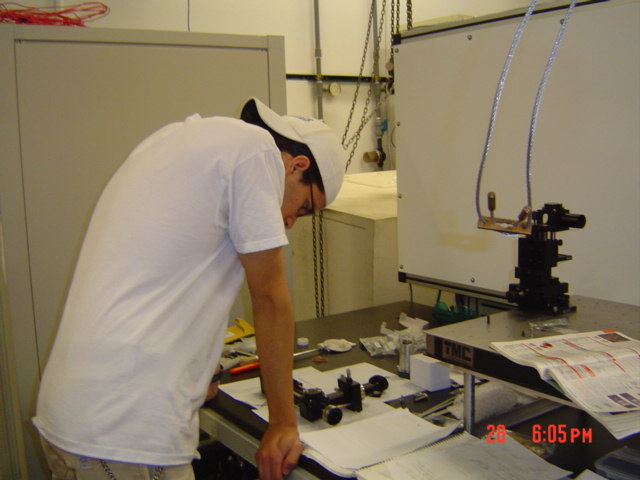 |
In the high pressure science and engineering center (HiPSEC) research is done on samples under high pressure. The samples are placed in between two diamonds since diamonds are very strong. The diamonds are mounted in a diamond anvil cell that can be tightened to high pressure. The question is how to measure the pressure. A mechanical device cannot be used to measure the pressure because it will not be very accurate and the area under pressure is quite small. Instead light is used to measure the pressure. We take advantage of properties of light waves to do so. When a sample is loaded, tiny ruby grains are added to the sample. The reason this is done is that when we shine a laser through the sample we can compare the sample what the spectrum looks like of a ruby at normal pressure. When pressure is applied to the sample the rubies are under that same pressure and we see the spectrum change position. This shift in position of the spectrum corresponds to a given pressure and the pressure of the sample can be calculated. This piece of equipment that measures the pressure of a sample is called a Ruby Fluorimeter. My project was to build a second Ruby Fluorimeter for the HiPSEC lab. The difference in the second Ruby Fluorimeter that I am building is the absorption spectrum can observed as well as have a second unit to measure the pressure. |
| Carlos Parada of University of Texas: Arlington working with Prof. Michael Pravica. | 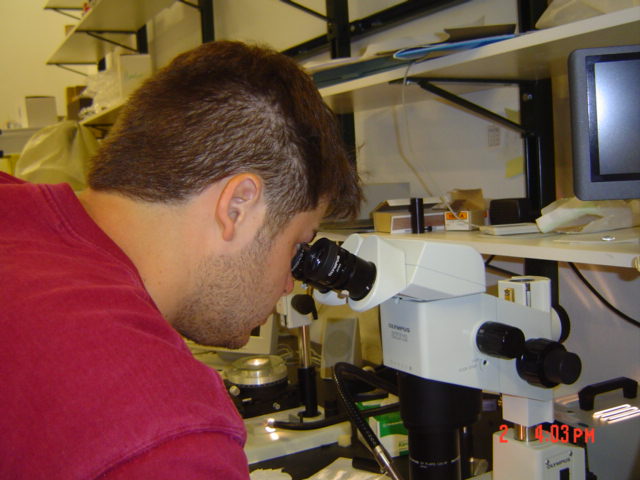 |
We designed and built a glove box for cryogenic loading of diamond anvil cells (DAC). The design incorporated two inlets, an outlet for gas purging, a thermocouple connection and a pressure relief valve. The system was utilized for successful condensation of oxygen into a liquid. A future experiment will make use of this technique to load a Merrill-Basset type DAC in order to study the crystalline structure of epsilon-oxygen. |
| Patricia Kalita of Colorado State University: Pueblo working with Prof. James Selser. | No pic? | Need Abstract. |
| Zachary Quine of UNLV working with Prof. Michael Pravica on "Explorations of the Detonation Threshold of the High Explosive PETN." | 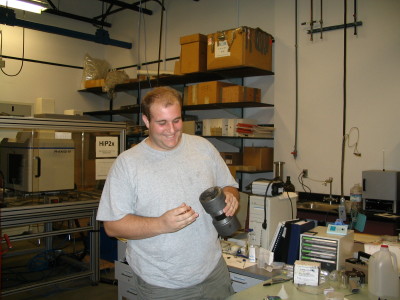 |
Decomposition is the first step in the process of an explosion. In this experiment I will determine several decomposition points for PETN by observing samples at high Pressures and Temperatures. By fitting that data into a Hugoniot adiabat we will have the decomposition wave of this explosive. By finding the decomposition wave of PETN, and what it decomposes into, we will not only have a better understanding of the dynamics of the explosion but we will also be able to use the information to protect PETN from shocks that are large enough to initiate decomposition, thereby making a safer explosive. |
| Elizabeth Sokol of SUNY Buffalo working with Prof. Malcolm Nicol. | 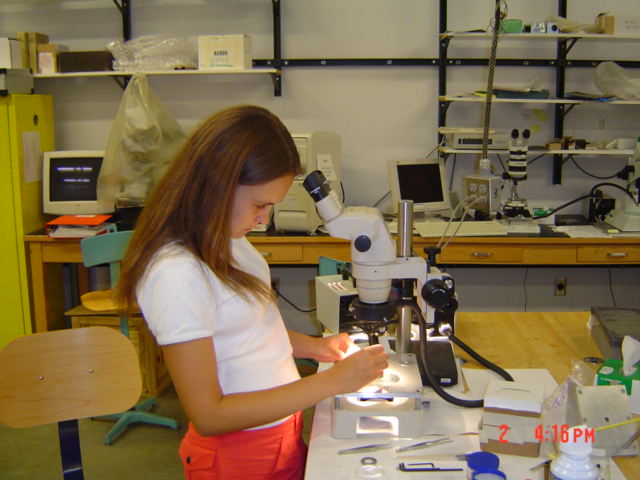 |
We performed a pressure analysis of adamantane up to 43 GPa. The R1 and R2 lines of ruby had clear resolution through the entire pressure range. We observed broadening of the R1 line and an increase in the R1- R2 separation for most pressures. Due to its non-hydrostatic behavior adamantane is unsuitable as a pressure medium. |
| Paul Stokes of West Virginia University working with Prof. John Farley. | 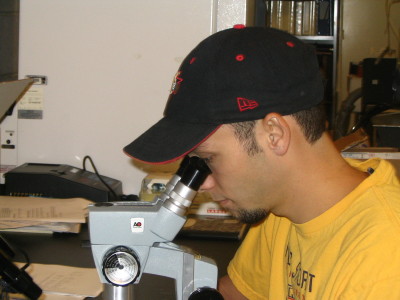 |
We are currently using materials science tools to study embryotic Zebrafish (Brachydanio rerio), a powerful model in biological science. We are examining the notocord (backbone ~2mm long) of an embryotic zebrafish after extracting it with a dissecting microscope and micro dissection tools. The Scanning Electron Microscope (SEM) is used to perform an Elementary Dispersion Analysis using X-Rays (EDAX) which determines the composition of the bone and verifying that it is indeed bone. Performing these procedures repeatedly will lead to a tissue culture of the bone in the future. New biomaterials for calcified tissue are needed for replacement teeth and prosthetics. Using the resources available at UNLV our research group will be able to analyze the biological, chemical, structural, and mechanical properties of the new calcified tissue. Eventually extracting the nanoscale tooth buds from embryotic Zebrafish will enable us to perform a tissue culture and grow our own teeth. |
| Brittany Webb of Utah State University working with Prof. Andrew Cornelius. |  |
Heat capacity measurements were taken at low temperatures and high magnetic fields using the Physical Property Measurement System (PPMS) on Tb2Ti2O7 and four Sn substituted forms (Tb2Ti1.95Sn0.05O7, Tb2Ti1.9Sn0.1O7, Tb2TiSnO7, and Tb2Sn2O7). From the measurements, it is possible to calculate the internal magnetic field (hyperfine) at the Tb nucleus that is due to magnetic order (or how geometrically un-frustrated the lattice is). It was found that the Sn substitution caused the Tb moments to reach a magnetically stable state at lower magnetic fields. Complete substitution of Sn for Ti leads to a magnetically ordered state in zero applied field. |
Last Updated: August 2, 2004